Brain scan and exam find MS and a brain tumor in one man
By MS Buddy ·
Summarized from Oxford medical case reports, Nov 2026 · PubMed. AI-generated summary. Not medical advice.
1 person · Man with MS and a brain tumor in the Democratic Republic of Congo
Research by Ali Medou Zaouil, Marie-Thérèse Sombo and 3 colleagues at the University of Kinshasa.
How did doctors identify both MS and a brain tumor in one person?
Key Takeaway
A brain scan and exam helped doctors identify both MS and a brain tumor in one man.

What They Found
The man had nerve symptoms that came back over time. Doctors used an exam, a brain scan, and rules for diagnosing MS. They found that he had both MS and a brain tumor. His condition stayed stable after treatment with methotrexate (a medicine that lowers immune activity). The report describes no further flare-ups after treatment.
Who Should Care and Why
The report describes a 25-year-old man living in the Democratic Republic of Congo. It is about the challenge of diagnosing and treating MS when a brain tumor is also present. The case shows how a brain scan helped doctors identify both conditions. The authors highlight the value of brain scans in places with limited medical resources.
Important Considerations
This was a case report (a description of one person's medical care). There was no comparison group, so the report cannot show whether the medicine caused his condition to stabilize. The abstract does not say how long he was followed after treatment.
AI-generated summary — for informational purposes only, not medical advice
Read the original abstract
Published in Oxford medical case reports by et al.. Reproduced from the PubMed record.
Multiple sclerosis (MS) is a demyelinating disease of the central nervous system that remains rare in sub-Saharan Africa. The coexistence of MS with intracranial tumors presents significant diagnostic and therapeutic challenges. We report the case of a 25-year-old male residing in the Democratic Republic of Congo (DRC) who presented with relapsing neurological deficits. Clinical evaluation and magnetic resonance imaging (MRI) based on the revised 2017 McDonald criteria confirmed the concomitant presence of MS and a temporal brain tumor (meningioma). Treatment with methotrexate led to complete disease stabilization without subsequent flare-ups. This rare association highlights the critical role of neuroimaging in resource-limited settings where demyelinating disorders are frequently underdiagnosed.
Categories
Explore more research
Check out the MS Buddy app
It’s free, with no ads. Built by people living with MS.


Related MS research

11/25/2026
People with MS had more bright spots in one layer at the back of the eye than healthy volunteers, bu
Read More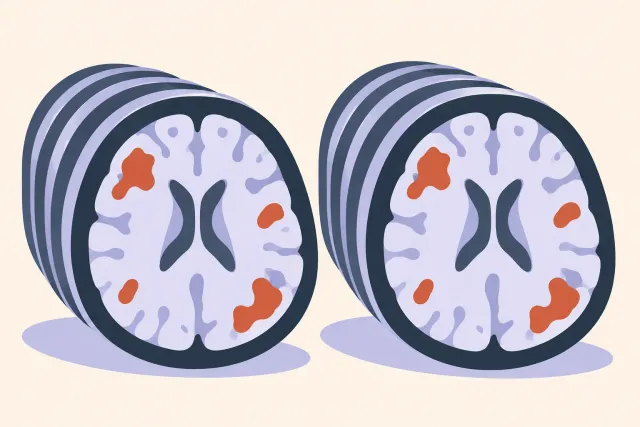
11/25/2026
A new method measured severe tissue damage on 3D brain scans from people with MS. The totals closely
Read More
11/20/2026
In a study of 140 people, a spinal fluid test better separated MS from other nervous system conditio
Read More
11/20/2026
In people with MS, brain scan readings were stronger when images lined up with the scanner’s magneti
Read More
11/20/2026
A study of 59 people with relapsing-remitting MS found a computer tool helped doctors read brain sca
Read More
11/19/2026
A Japanese hospital study linked MS to about 9% of first eye nerve inflammation cases. Other immune
Read MoreNot all studies carry the same weight: sample size, study design and whether results were replicated all matter. The credibility score above reflects the journal, and the original paper is linked under More Details. Read how MS Buddy selects and scores research, and talk to your MS care team before acting on any study.