Pregnancy may affect MS and other diseases differently
By MS Buddy ·
Summarized from Immunologic research, Nov 2026 · PubMed. AI-generated summary. Not medical advice.
Review · women with MS and other diseases involving misdirected immune attacks
Research by Patrycja Pelczar, Paulina Gil-Kulik and 3 colleagues at the Medical University of Lublin in Poland.
How might pregnancy affect MS and other diseases involving the body's defenses?
Key Takeaway
Pregnancy changes the body's defenses in ways that may affect MS and other diseases differently.
What They Found
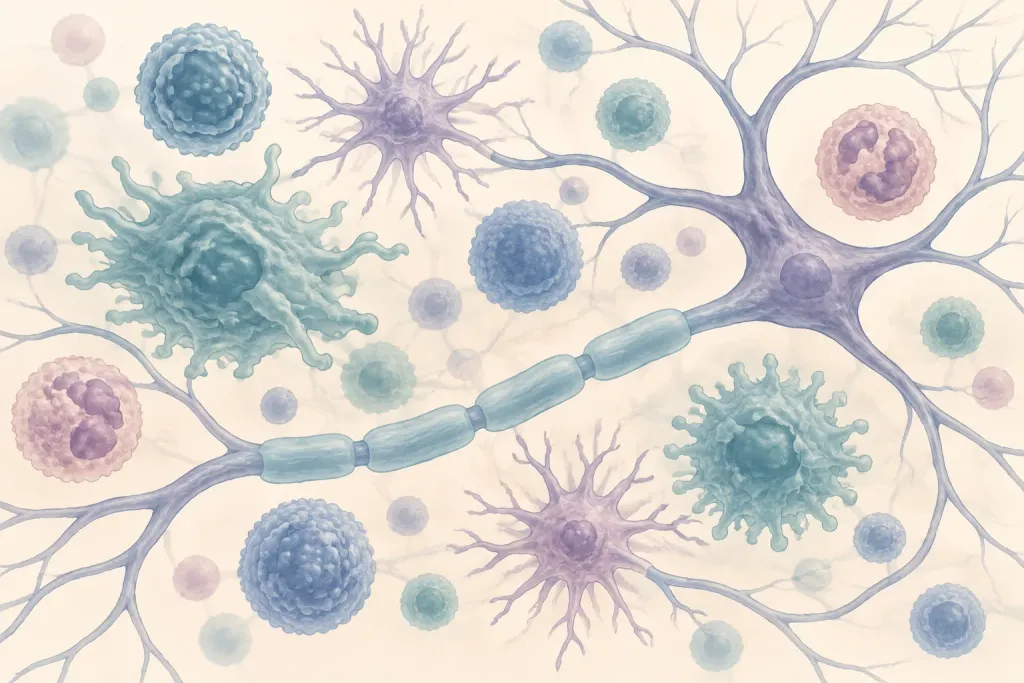
The review links genes, hormones, and pregnancy-related changes to diseases in which the body's defenses attack its own tissues. Different hormones have different effects on how the body's defenses work. Pregnancy may affect disease activity and pregnancy outcomes differently across the diseases reviewed. Fetal microchimerism (cells from a fetus remaining in the mother's body) may have lasting effects on the body's defenses. These cells may help control the body's defenses or contribute to attacks on its own tissues.
Who Should Care and Why
This review concerns women with MS and other diseases in which the body's defenses attack its own tissues. It examines pregnancy and the period after childbirth. MS is one part of the review, not its sole focus. The review explores how pregnancy and these diseases may affect each other. Its conclusions emphasize care tailored to each woman's risks rather than a single approach for everyone.
Important Considerations
This article reviews existing studies rather than reporting a new trial, and it gives no total participant count. It does not establish a specific effect of pregnancy on MS activity. You cannot tell from this abstract how pregnancy would affect an individual's MS.
AI-generated summary — for informational purposes only, not medical advice
Read the original abstract
Published in Immunologic research by et al.. Reproduced from the PubMed record.
Autoimmune diseases (ADs) affect 5-10% of the population, with 80-85% of diagnosed patients being women. This pronounced sexual dimorphism is influenced by genetic factors (X chromosome), fluctuations in sex hormones, and unique immunological changes occurring during pregnancy and the postpartum period. These factors contribute to women's distinct susceptibility to autoimmune disorders and may influence their clinical course. This narrative review critically evaluates the immunological, hormonal, and pregnancy-related factors contributing to female autoimmunity with particular emphasis on the bidirectional interactions between pregnancy-induced immunomodulation and maternal autoimmunity. By contrasting four distinct diseases systemic lupus erythematosus (SLE), rheumatoid arthritis (RA), multiple sclerosis (MS), and type 1 diabetes (T1D), representing different immune paradigms (type 1 T helper (Th1) vs. type 2 T helper (Th2), systemic vs. organ-specific), we aim to analyze how mechanisms like placental tolerance and fetal microchimerism specifically shape disease trajectories and obstetric outcomes, contextualized within the evolutionary pregnancy compensation hypothesis. A literature review (PubMed, Scopus, Web of Science) was conducted to synthesize clinical and molecular evidence. The mechanisms of placental immune tolerance, the phenomenon of fetal microchimerism, and the evolutionary pregnancy compensation hypothesis were analyzed. Selected autoimmune diseases were used to illustrate disease-specific manifestations of these mechanisms. The literature highlights the complex interplay between genetic, hormonal and immunological factors in female autoimmunity. Estrogens, progesterone, androgens and prolactin exert distinct immunomodulatory effects influencing immune cell activity, cytokine production and immune tolerance. Fetal microchimerism (FMc) may have long-term immunological consequences, potentially contributing to either immune regulation or autoimmune pathology. These mechanisms may help explain the variable effects of pregnancy on autoimmune disease activity and obstetric outcomes, as illustrated by SLE, RA, MS, and T1D. The pregnancy compensation hypothesis offers an additional evolutionary perspective. However, it remains speculative and requires further investigation. Pregnancy induces complex, disease-specific immunomodulatory changes. Instead of one-size-fits-all regimens, caring for pregnant women with autoimmune disease requires a highly personalized and multidisciplinary approach based on risk stratification and monitoring of specific biomarkers. Current evidence suggests an intriguing influence of molecular changes on the course of autoimmunity; however, a full understanding of these mechanisms requires further, targeted research.
Categories
Explore more research
Check out the MS Buddy app
It’s free, with no ads. Built by people living with MS.


Related MS research
11/19/2026
A review of 50 studies found wide differences in MS rates across the Americas. MS became more common
Read More
11/20/2026
A study of online MS medication discussions found two main styles: sharing personal experiences and
Read More
11/18/2026
A review finds limited direct evidence that diet, exercise, or gut microbes affect MS through the bo
Read More
11/19/2026
Interviews with 17 people newly diagnosed with relapsing-remitting MS explored fear, doubt, and unce
Read More
11/15/2026
A survey of 24 Israeli MS specialists found agreement on weighing more than age when treating older
Read More
11/12/2026
A blood study found higher mercury and chromium, but lower aluminum and titanium, in people with MS
Read MoreNot all studies carry the same weight: sample size, study design and whether results were replicated all matter. The credibility score above reflects the journal, and the original paper is linked under More Details. Read how MS Buddy selects and scores research, and talk to your MS care team before acting on any study.