After MS relapses, cells fighting Epstein-Barr rose
By MS Buddy ·
Summarized from Neurology(R) neuroimmunology & neuroinflammation, Jan 2027 · PubMed · DOI. AI-generated summary. Not medical advice.
Observational study · 5 people with MS who had relapses, compared with healthy people
Research by Leslie Adda, David Klatzmann and 11 colleagues at Sorbonne Université in France.
Do Epstein-Barr virus-fighting cells increase after MS relapses?
Key Takeaway
After MS relapses, blood cells that fight the Epstein-Barr virus increased, alongside cells that fight other viruses.
What They Found
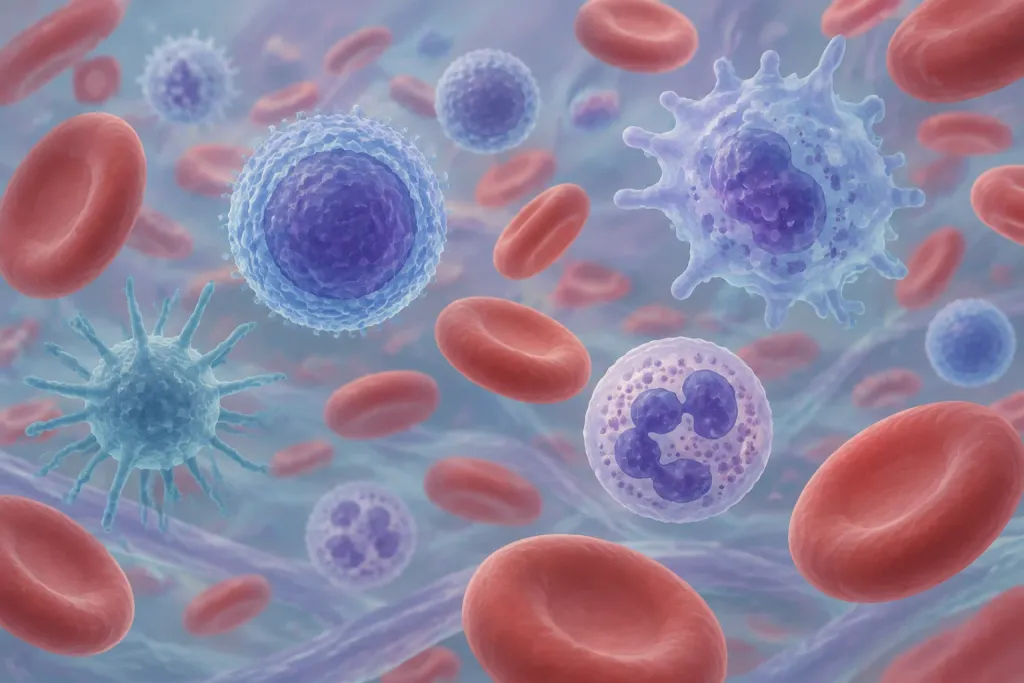
Researchers compared blood samples taken before and after relapses in people with MS. After relapses, cells that recognize the Epstein-Barr virus became more common across several groups of immune cells. Cells that recognize other viruses showed similar increases. Before relapses, one group of Epstein-Barr virus-fighting cells was more common in people with MS than in healthy people. The findings link relapses with broad immune activity, not just a response to one virus.
Who Should Care and Why
The researchers studied people with MS who had relapses and compared some results with healthy people. They looked at blood collected over time, rather than at one visit. The study is about how immune cells change around a relapse. It found changes in cells that recognize several viruses. The researchers said a trigger for these changes remains unknown.
Important Considerations
This was an observational study of five people with MS. The study shows that immune cell changes occurred around relapses, but it does not show what caused the relapses. Larger studies are needed to clarify the role of these cells.
AI-generated summary — for informational purposes only, not medical advice
Read the original abstract
Published in Neurology(R) neuroimmunology & neuroinflammation by et al.. Reproduced from the PubMed record.
Epstein-Barr virus (EBV) infection is strongly implicated in multiple sclerosis (MS), yet the mechanisms linking EBV to disease pathogenesis remain unclear. EBV-specific T cells are hypothesized to contribute to MS through molecular mimicry. We aimed to investigate the relationship between EBV-specific T cells and MS relapses using longitudinal T-cell receptor (TCR) repertoire profiling. We analyzed TCR repertoires from sequential peripheral blood samples collected before and after relapses in 5 patients with MS. CD4+ and CD8+ T cells were sorted into naive, memory, and regulatory subsets. TCR antigen specificity was determined using exact matches to public databases and GLIPH2-based clustering, covering EBV, cytomegalovirus, influenza, Mycobacterium tuberculosis, and self-antigens. The results were compared with those from healthy controls. At baseline, patients with MS showed a significant enrichment of EBV-specific TCRs within CD8+ T cells, comparable with patterns seen in other autoimmune diseases. After relapses, EBV-specific TCR frequencies markedly increased across all T-cell subsets. TCRs recognizing other viral antigens, including polyspecific TCRs with broad reactivity, displayed similar baseline enrichment and relapse-associated expansion patterns. Our findings indicate a temporal association between MS relapses, global immune activation, and EBV-specific T-cell expansions, which is consistent with a two-step model of MS relapse immunopathogenesis. An initial, unidentified trigger induces broad immune activation, promoting the expansion of antiviral T cells, including those specific to EBV. These EBV-specific and polyspecific T cells with heightened cross-reactivity may then contribute to MS relapses. Larger studies are needed to further define the role of T-cell dynamics in MS pathogenesis.
Categories
Check out the MS Buddy app
It’s free, with no ads. Built by people living with MS.


Related MS research
11/23/2026
A lower-strength MRI spotted loss of the protective covering around nerve fibers in mice. Stronger s
Read More
12/1/2026
In a mouse study related to MS, more immune cells gathered in the brain and spinal cord after a last
Read More
11/20/2026
A review looks at changes in how the body uses tryptophan (a building block of proteins) in MS and o
Read More
11/19/2026
Five people with MS received engineered immune cells. Spinal fluid immune changes were seen, but saf
Read More
11/20/2026
A small study followed brain connections and thinking in early MS over 10 months. Patterns differed
Read More
11/20/2026
A global study including childhood MS found rising rates and disability from rare childhood brain an
Read MoreNot all studies carry the same weight: sample size, study design and whether results were replicated all matter. The credibility score above reflects the journal, and the original paper is linked under More Details. Read how MS Buddy selects and scores research, and talk to your MS care team before acting on any study.