Gene differences linked to MS risk and worse disease
By MS Buddy ·
Summarized from Molecular biology reports, Nov 2026 · PubMed. AI-generated summary. Not medical advice.
Observational study · people with MS and healthy people without nervous system or immune diseases
Research by Eman Abdel-Rahim Ghobashy, Mustafa Saleh and 3 colleagues at Menoufia University in Egypt.
Are gene differences linked to MS risk and disease severity?
Key Takeaway
Differences in two genes were linked to higher MS risk, while a difference in another gene was linked to worse disease.
What They Found
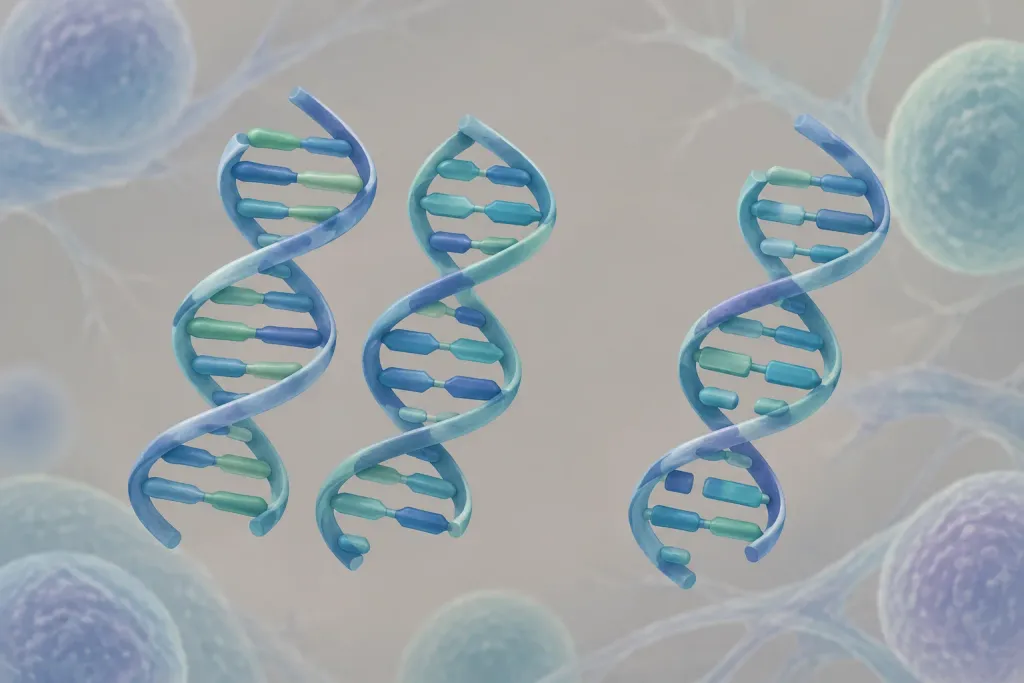
Differences in two of the genes studied were linked to a greater chance of having MS. These links remained when researchers considered other factors in their analysis. A difference in another gene was linked to worse disease, but its link to developing MS was not clear. Higher vitamin D levels were linked to a lower chance of having MS. Higher red blood cell levels were also linked to a lower chance of having MS.
Who Should Care and Why
The study compared people with MS and healthy people without a history of nervous system diseases or diseases involving attacks by the immune system. The groups were matched for age, sex, and social and economic background. The findings concern genetic differences linked to having MS or experiencing worse disease. They also concern links between MS and vitamin D and red blood cell levels. The abstract does not identify which forms of MS were studied.
Important Considerations
This observational study compared people with and without MS, but the abstract does not report the number of participants. The findings show links, not proof that these gene differences or blood levels cause or prevent MS. It did not test whether taking vitamin D changes your MS risk or disease course.
AI-generated summary — for informational purposes only, not medical advice
Read the original abstract
Published in Molecular biology reports by et al.. Reproduced from the PubMed record.
Multiple sclerosis (MS) is a chronic autoimmune disease affecting the central nervous system (CNS) with a global prevalence of 23.9 cases per 100,000 population. The present study was conducted to assess the impact of MIF, EPHX2, and BCHE SNPs on MS pathogenesis and prognosis. This case-control study was undertaken in collaboration with the Department of Medical Biochemistry and Molecular Biology, Faculty of Medicine, Menoufia University, and the Faculty of Applied Health Sciences Technology, Menoufia University. Participants were categorized into two groups. • Group 1: Patients diagnosed with multiple sclerosis (MS). • Group 2: healthy controls matched for age, gender, and socioeconomic position, with no history of neurological or autoimmune disorders. It was found that MIF (GC + CC) and EPHX2 (AG + GG) genotypes pushed the risk up sharply, by 600% and 338.3% respectively. From multivariate analysis, MIF (GC + CC) and EPHX2 (AG + GG) were found to be independent predictors of MS. The BCHE TT genotype did not reach significance for disease onset but was significantly linked to a worse clinical course. In contrast, each unit rise in RBC reduced MS risk by 71.3%, and vitamin D by 29.5%. MIF (GC + CC) and EPHX2 (AG + GG) variants are associated with MS susceptibility, while the BCHE TT genotype trended with severity, while vitamin D and red blood cells have shown a protective effect, highlighting biological pathways for future study.
Categories
Explore more research
Check out the MS Buddy app
It’s free, with no ads. Built by people living with MS.


Related MS research

11/17/2026
Genetic and brain scan data linked inherited brain structure patterns to MS risk. Researchers also f
Read More
11/11/2026
This review compares inherited and environmental risks for MS starting in childhood or adulthood, in
Read More
11/4/2026
Could a short voice recording help track MS changes? Learn why speech-checking tools show promise fo
Read More
1/1/2027
Explore a study linking a gene change to immune cells in spinal fluid in MS, what those cells may sa
Read More
1/1/2027
A Korean study found higher levels of one Epstein-Barr virus antibody in people with MS. Learn why t
Read More
10/26/2026
A rare inherited condition can look like MS and cause stiff legs. Learn how spine scans and genetic
Read MoreNot all studies carry the same weight: sample size, study design and whether results were replicated all matter. The credibility score above reflects the journal, and the original paper is linked under More Details. Read how MS Buddy selects and scores research, and talk to your MS care team before acting on any study.