In mice, treated B cells eased MS-like disease signs
By MS Buddy ·
Summarized from Biomaterials science, Nov 2026 · PubMed · DOI. AI-generated summary. Not medical advice.
Animal study · mice with an MS-like disease and B cells studied in the lab
Research by Kierstin Clark, Kristy Ainslie and 14 colleagues at Eshelman School of Pharmacy in the United States.
Did B cells carrying specially made particles ease MS-like disease in mice?
Key Takeaway
In mice with an MS-like disease, B cells carrying specially made particles reduced disease signs.
What They Found
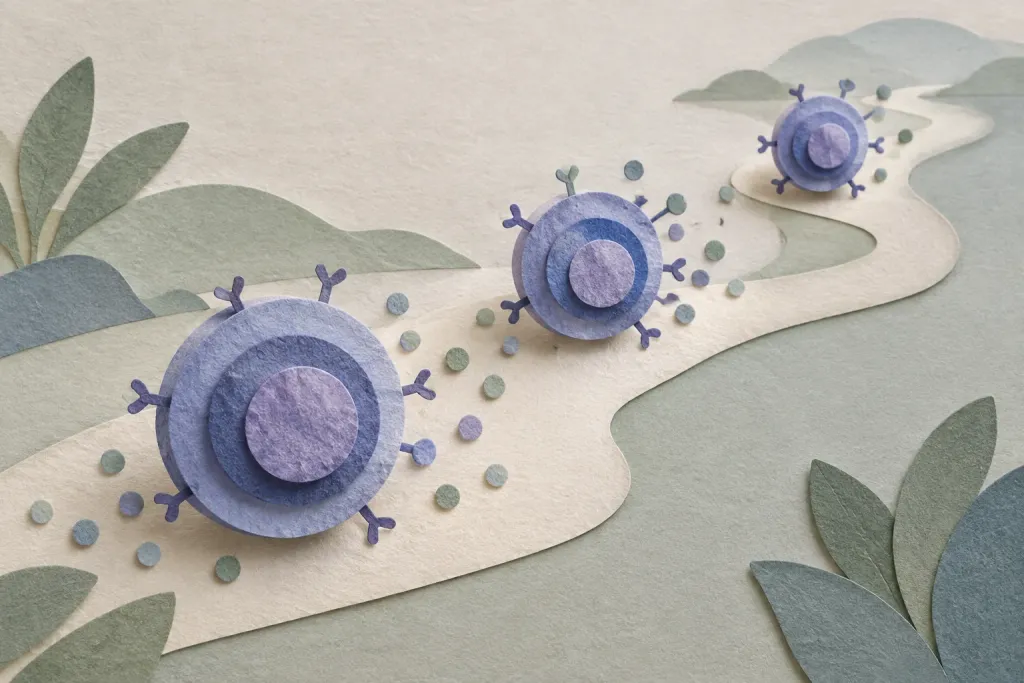
Researchers changed how they made tiny particles designed to stick to B cells, a type of immune cell. Changes to the particles strongly affected how well they attached. The team put a piece of nerve covering inside the particles and attached them to B cells. They then gave those B cells to mice with an MS-like disease. The mice had lower disease scores, meaning fewer signs of illness on the study's rating scale.
Who Should Care and Why
This study tested mice with an MS-like disease and B cells prepared outside the body. It may interest people following research into treatments aimed at a specific immune response. The particles were designed to attach to B cells rather than enter them. How the particles were made affected that attachment. The mouse results do not show whether this approach works for people with MS.
Important Considerations
You should know this was an early study in mice, not a treatment trial in people. The abstract does not state how many mice were tested. It does not show whether the approach is safe or effective for you.
AI-generated summary — for informational purposes only, not medical advice
Read the original abstract
Published in Biomaterials science by et al.. Reproduced from the PubMed record.
Multiple sclerosis (MS) is an autoimmune disease currently being treated with broad immunosuppressive drugs. However, antigen-specific therapies offer a strategy to selectively reestablish self-tolerance within the autoreactive T cell compartment with fewer side effects. Polymeric microparticles are an effective platform for encapsulating disease-relevant antigens to achieve antigen-specific T cell tolerance via uptake by antigen-presenting cells (APCs). For this purpose, the most commonly targeted APCs are dendritic cells (DCs). However, B cells also present antigen and have demonstrated therapeutic efficacy in MS when targeted by depleting anti-CD20 antibodies. Microparticles comprised of the polymer acetalated dextran (Ace-DEX) bind to B cells more efficiently than other biomaterial systems and reside at the surface without internalization due to microparticle size. In this work, we systematically varied Ace-DEX parameters, including the fabrication method, molecular weight, hydrophobicity, and acetal exposure to understand the relationship between these properties and microparticle binding to B cells. These features strongly influenced B cell association, highlighting the sensitivity of immune recognition to polymer chemistry. The Ace-DEX MPs (AMPs) were evaluated in a preclinical MS model (experimental autoimmune encephalomyelitis (EAE)) using an adoptive transfer of ex vivo B cells surface decorated with MOG35-55 loaded AMPs and achieved a significant decrease in the clinical score. This work demonstrates the role of polymer properties in B cell binding and outcomes as an antigen-specific therapeutic vaccine.
Categories
Explore more research
Check out the MS Buddy app
It’s free, with no ads. Built by people living with MS.


Related MS research
11/23/2026
A lower-strength MRI spotted loss of the protective covering around nerve fibers in mice. Stronger s
Read More
12/1/2026
In a mouse study related to MS, more immune cells gathered in the brain and spinal cord after a last
Read More
11/20/2026
A review looks at changes in how the body uses tryptophan (a building block of proteins) in MS and o
Read More
11/19/2026
Five people with MS received engineered immune cells. Spinal fluid immune changes were seen, but saf
Read More
11/20/2026
A small study followed brain connections and thinking in early MS over 10 months. Patterns differed
Read More
11/20/2026
A global study including childhood MS found rising rates and disability from rare childhood brain an
Read MoreNot all studies carry the same weight: sample size, study design and whether results were replicated all matter. The credibility score above reflects the journal, and the original paper is linked under More Details. Read how MS Buddy selects and scores research, and talk to your MS care team before acting on any study.