People with MS described hidden work to stay employed
By MS Buddy ·
Summarized from Qualitative health research, Nov 2026 · PubMed · DOI. AI-generated summary. Not medical advice.
Observational study · 21 people with MS in France discussing their professional lives
Research by Pierre Brasseur at Université libre de Bruxelles in Belgium.
What hidden work do people with MS describe while staying in professional life?
Key Takeaway
People with MS in France described hidden work involved in managing medical care and staying in professional life.
What They Found
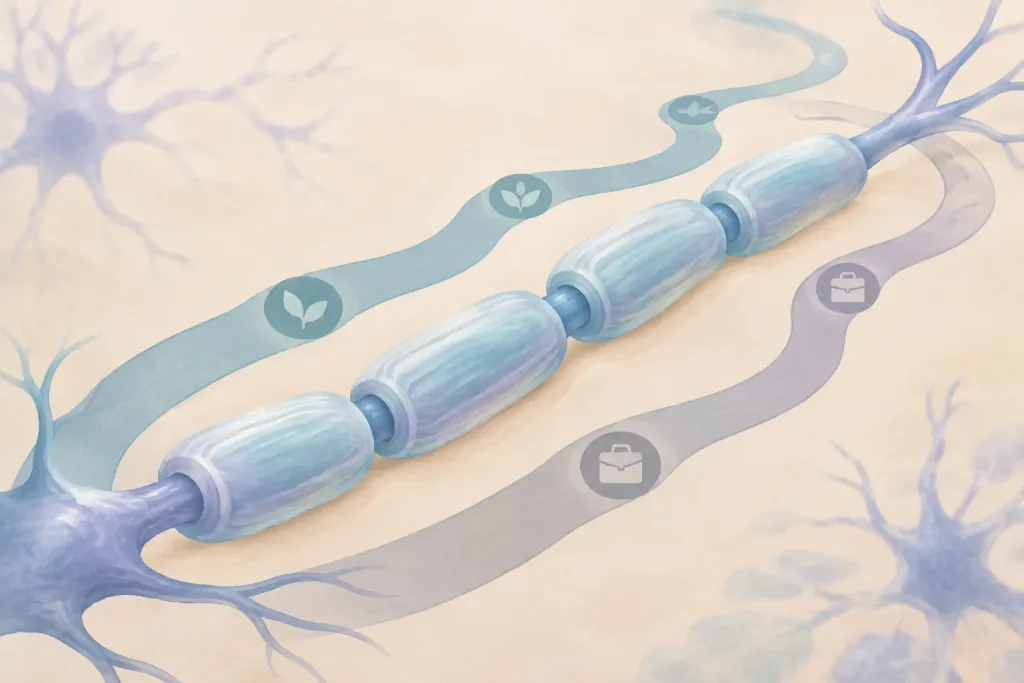
People described navigating medical care that felt fragmented. They learned to recognize patterns in their own symptoms and explain what they knew about their bodies. They also managed emotions while dealing with illness and work. Many worked to reshape how they saw themselves as professionals. The researcher found that gaps in medical and workplace systems added to this work.
Who Should Care and Why
The study involved people living with MS in France who discussed their professional lives. It focused on how they handled medical care alongside work. Their accounts showed that living with MS could require knowledge that medical professionals did not always provide. The study also examined the effort involved in maintaining a professional identity. It may interest caregivers who want to understand work that is often hard to see.
Important Considerations
The study used 21 interviews with people in France, rather than testing a treatment. Their accounts describe their experiences but do not show how common those experiences are. The abstract does not report whether any particular workplace change helped.
AI-generated summary — for informational purposes only, not medical advice
Read the original abstract
Published in Qualitative health research by . Reproduced from the PubMed record.
This article examines how individuals living with multiple sclerosis (MS) negotiate biomedical authority and embodied expertise while maintaining professional lives. Drawing on 21 biographical interviews conducted in France, I reveal how MS creates an epistemological crisis in which individuals must simultaneously navigate fragmented medical systems, produce sophisticated bodily knowledge, and reconstruct professional identities. I conceptualize professional adaptation not as technical problem-solving but as a cultural practice involving negotiations between competing knowledge systems: a form of structural demand imposed on individuals by institutional environments not designed for chronic, invisible, episodic disability. Four interrelated dimensions are identified: medical pluralism and institutional choreography, embodied expertise production, emotional labor management, and identity reconstruction through narrative negotiation. Findings challenge frameworks that position chronically ill individuals as passive subjects and reveal disability as a productive site where different ways of knowing the body intersect with institutional power. This research contributes to qualitative health research by making visible the work that individuals perform not despite the system, but because of its failures.
Categories
Explore more research
Check out the MS Buddy app
It’s free, with no ads. Built by people living with MS.


Related MS research

11/19/2026
A review of 50 studies found wide differences in MS rates across the Americas. MS became more common
Read More
11/20/2026
A study of online MS medication discussions found two main styles: sharing personal experiences and
Read More
11/18/2026
A review finds limited direct evidence that diet, exercise, or gut microbes affect MS through the bo
Read More
11/19/2026
Interviews with 17 people newly diagnosed with relapsing-remitting MS explored fear, doubt, and unce
Read More
11/18/2026
This review explores how pregnancy may affect MS and other diseases involving immune attacks on the
Read More
11/15/2026
A survey of 24 Israeli MS specialists found agreement on weighing more than age when treating older
Read MoreNot all studies carry the same weight: sample size, study design and whether results were replicated all matter. The credibility score above reflects the journal, and the original paper is linked under More Details. Read how MS Buddy selects and scores research, and talk to your MS care team before acting on any study.