MS Research Roundup: April 2023
The multiple sclerosis research published in April 2023, explained in plain language. Studies are listed by how much they matter to people living with MS, most first.
The month at a glance
- 16 studies published this month.
- Newest study published April 25, 2023.
- 7 in people, 3 in the lab or in animals, 6 reviews of earlier research.
- Largest study: 578 people.
- Research from 40 institutions in 16 countries, including IRCCS San Raffaele Scientific Institute, Ain Shams University and Copenhagen University Hospital.
- Forms of MS studied: primary progressive (2), relapsing-remitting (2), secondary progressive (2).
- Symptoms studied: feeling tired (2), thinking problems (2).
Studies published in April 2023

Stopping some MS drugs in pregnancy may raise relapse risk
This review covers pregnancy and MS, including relapse risks after stopping some treatments and limited information on babies exposed before birth or through breast milk.

MS worsening without relapses may start early in disease
A review describes how MS can worsen without relapses, even early on. It discusses possible causes and brain scans that may help researchers study this process.

Early blood test linked to later MS disability worsening
A study of 578 people after a first MS-like attack linked higher levels of a blood marker to later disability worsening. It did not test a treatment.

MS drugs that calm immune cells show early trial benefits
A review finds encouraging early trial results for MS drugs that reduce immune cell activity. Their long-term effects and use after other treatments remain unclear.

Computer-made MRI scans found more MS lesions in one test
In scans from 202 people with MS, one computer-made image type showed more lesions than images taken directly by MRI. Another showed about the same number.

Brain scan method may tell MS from an MS look-alike
A study of 47 people found a brain lesion pattern much more often in MS than in an MS look-alike condition. Researchers explored its use in diagnosis.

MS is more common farther from the equator: a review
A review examines why MS is more common farther from the equator. It discusses sunlight, vitamin D, and melatonin but does not test a treatment for MS.

Review explores gut fiber byproducts in MS and immunity
A review discusses how substances made by gut microbes from fiber may affect immune responses in MS and other autoimmune diseases. It reports no new treatment test.

Brain damage tied to thinking differs by sex in MS
A brain scan study found similar rates of thinking problems in men and women with MS, but differences in how brain damage related to their thinking test scores.
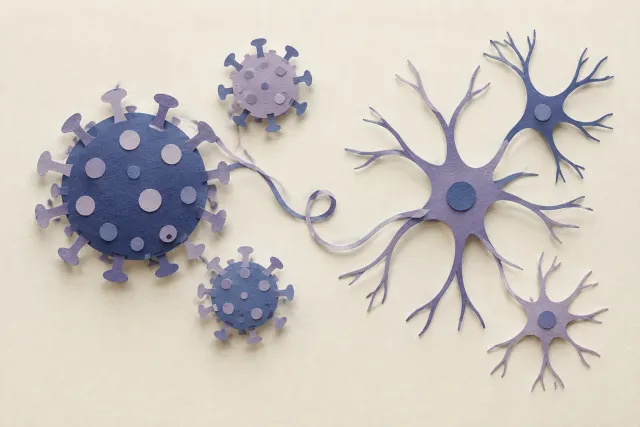
Review finds a widespread virus tied to MS development
A research review links Epstein-Barr virus to the development of MS. It explains what remains unclear about the virus's role in ongoing disease activity.

Brain tissue loss tracks thinking and disability in MS
In brain scans of people with MS, tissue loss was linked to disability and thinking problems. Researchers compared affected areas with maps of brain chemicals.

MS hospital stays varied by season in a national study
A US study found that hospital stays for MS varied by season. The abstract does not say which months had more stays or explain why the pattern occurred.

Brain changes in post-COVID fatigue overlap with MS
Brain scans found changes in people with lasting fatigue after COVID-19. Some overlapped with changes in people with MS and fatigue, but the study cannot show cause.
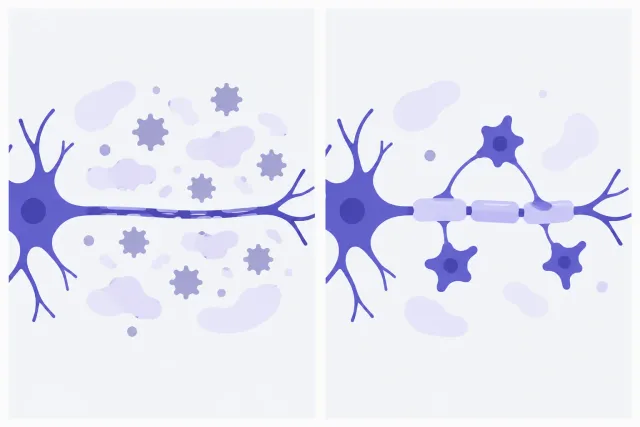
B-cell removal made MS-like disease worse in mice
Researchers studied people with MS, cells in a dish, and mice. Removing B cells increased immune activity and worsened MS-like disease in mice, not people.

MS optic nerves showed changes in normal-looking tissue
In donated optic nerve tissue, researchers found changes to nerve coverings in normal-looking areas affected by MS. These changes were linked to more immune cells.

New brain cell map tracks MS-like myelin loss in mice
A new map of mouse brain cells shows changes during loss and repair of the nerve covering. The study did not test a treatment or include people with MS.
Check out the MS Buddy app
Track symptoms, monitor wellness, and stay on top of your MS care. It’s free, with no ads. Built by people living with MS.

