Altered immune cells for MS are still in early study
By MS Buddy ·
Summarized from Autoimmunity reviews, Nov 2026 · PubMed. AI-generated summary. Not medical advice.
Review · MS and other disease models, plus people in early trials
Research by Simiao Chen, Qing Ye and 1 colleague at Zhejiang University School of Medicine and Westlake University in China.
What does early research show about altered immune cells for MS?
Key Takeaway
A review found that altered immune cells can focus their calming effects on specific targets, but evidence in people is still at an early stage.
What They Found
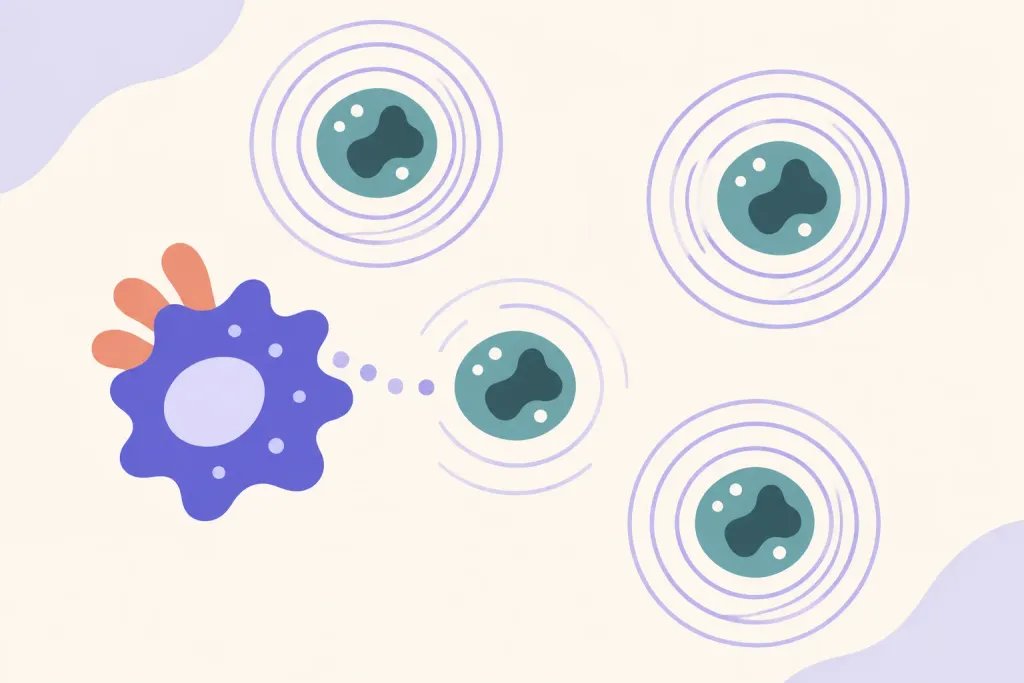
Some immune cells help keep the body's defenses in check. Cell treatments based on them can be hard to aim and may weaken the body's defenses too broadly. Researchers can alter these cells to recognize specific targets and calm immune activity there. The review looked at ways to help the altered cells keep working as intended and last longer. It also noted that making large amounts of these cells remains difficult.
Who Should Care and Why
This review covered early research on MS and other diseases where the body's defenses attack its own tissues. The MS evidence came from studies that modeled the disease, not from trials in people with MS. The review also covered early trials in people receiving transplants and people with diseases caused by immune attacks. Those trials focused on safety and whether the approach was practical.
Important Considerations
This article reviewed existing research rather than testing a treatment itself. The abstract does not report how many people took part in the trials it reviewed. The review does not show whether these altered cells can slow MS in people.
AI-generated summary — for informational purposes only, not medical advice
Read the original abstract
Published in Autoimmunity reviews by . Reproduced from the PubMed record.
Autoimmune diseases arise from a disruption of immune tolerance, leading to the persistent and pathological activation of autoreactive T and B cells. Although therapies based on regulatory T cells (Tregs) hold great promise for restoring immune homeostasis, their clinical application has been limited by insufficient antigen specificity and the risk of broad-spectrum immunosuppression. Chimeric antigen receptor (CAR) engineering has emerged as a powerful strategy to overcome these limitations, enabling Tregs to acquire antigen-specific recognition capabilities and perform targeted suppression independent of major histocompatibility complex (MHC) restriction. This article reviews research progress on CAR-Tregs in autoimmune diseases, analyzing their structural design, the role of gene editing in enhancing stability and persistence, and the molecular mechanisms of immunosuppression. Additionally, this review summarizes preclinical evidence from models of type 1 diabetes, multiple sclerosis, systemic lupus erythematosus, rheumatoid arthritis, and inflammatory bowel disease, highlighting the potential of this approach to alter disease progression. Furthermore, the current status of early-phase clinical trials in the fields of transplantation and autoimmune diseases is examined, with a focus on safety and feasibility data. Finally, barriers to clinical translation, such as phenotypic instability and challenges in large-scale production ,are identified, and future directions including modular CARs, universal products, in vivo engineering, and combination therapies are proposed. Overall, this review underscores the transformative potential of CAR-Tregs as a precision immunotherapy for autoimmune diseases, while emphasizing that clinical evidence remains at an early stage.
Categories
Explore more research
Check out the MS Buddy app
It’s free, with no ads. Built by people living with MS.


Related MS research
11/23/2026
A review links changes in how cells use fuel to MS and other immune diseases. These changes appear m
Read More
11/23/2026
A lower-strength MRI spotted loss of the protective covering around nerve fibers in mice. Stronger s
Read More
12/1/2026
In a mouse study related to MS, more immune cells gathered in the brain and spinal cord after a last
Read More
11/20/2026
A review looks at changes in how the body uses tryptophan (a building block of proteins) in MS and o
Read More
11/19/2026
Five people with MS received engineered immune cells. Spinal fluid immune changes were seen, but saf
Read More
11/20/2026
A small study followed brain connections and thinking in early MS over 10 months. Patterns differed
Read MoreNot all studies carry the same weight: sample size, study design and whether results were replicated all matter. The credibility score above reflects the journal, and the original paper is linked under More Details. Read how MS Buddy selects and scores research, and talk to your MS care team before acting on any study.