Brain connections helped predict brain shrinkage in MS
By MS Buddy ·
Summarized from Science advances, Nov 2026 · PubMed · DOI. AI-generated summary. Not medical advice.
Observational study · 2,187 people with MS who had brain scans
Research by Mar Barrantes-Cepas, Giuseppe Pontillo and 16 colleagues at the Medical University of Graz and Charles University in Prague and General University Hospital in Austria and Czechia.
Can brain connections help predict where brain tissue will shrink in MS?
Key Takeaway
Brain connections helped explain where brain tissue shrank in MS and improved predictions of future shrinkage.
What They Found
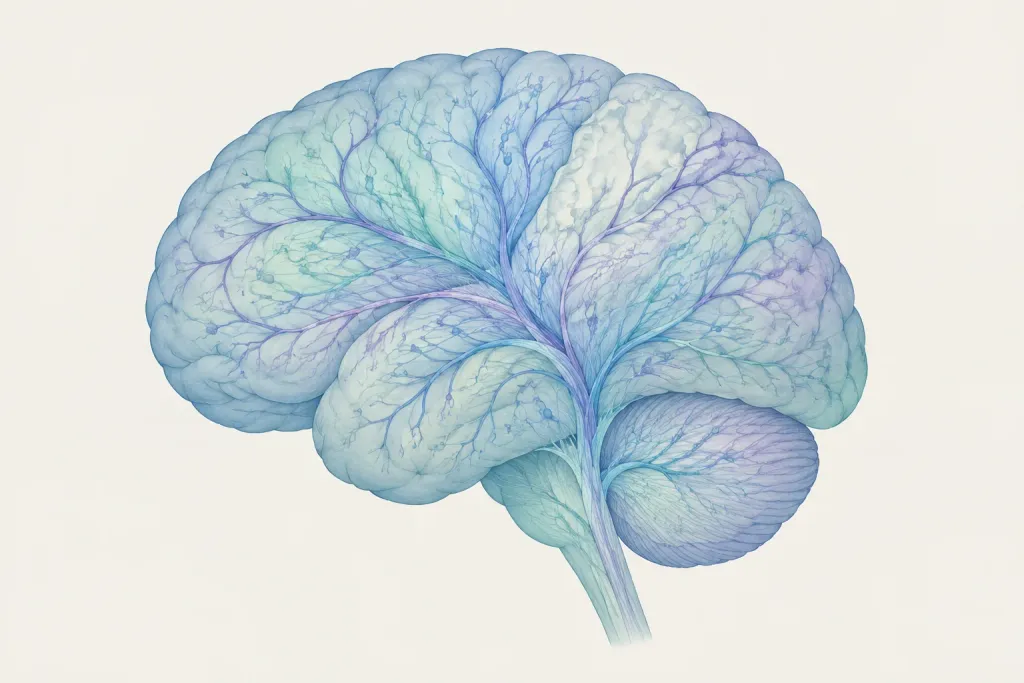
Researchers studied brain scans from people with MS. Brain areas with many connections tended to show more shrinkage. Patterns of shrinkage also followed connections between brain areas. Damage that disrupted connections and differences in gene activity played smaller roles. Measures of brain connections improved predictions of future shrinkage.
Who Should Care and Why
This study included people with MS who had brain scans. Brain tissue shrinkage is linked to worsening MS. The findings help explain why some brain areas shrink more than others. The researchers also found that these patterns may differ across forms or stages of MS. The abstract does not say which forms showed which patterns.
Important Considerations
The researchers analyzed brain scans from 2,187 participants and used other data for comparison. The findings show links between brain connections and shrinkage, not proof that connections cause it. The abstract does not say how accurate the future predictions were.
AI-generated summary — for informational purposes only, not medical advice
Read the original abstract
Published in Science advances by et al.. Reproduced from the PubMed record.
Clinical progression is strongly linked to gray matter atrophy in multiple sclerosis (MS), detectable early on MRI and progressing nonrandomly across the brain. However, the mechanisms driving its spatiotemporal progression and individual variability remain unclear. Using MRIs from 2187 participants, alongside normative data, we systematically investigated network-based mechanisms underlying MS-related atrophy. Regional atrophy was associated with functional cortical hubness, supporting the nodal stress hypothesis, and was constrained by anatomical and functional connections, consistent with transneuronal degeneration. Lesional disconnection and transcriptomic vulnerability played marginal roles. Patient- and subgroup-level analyses revealed that network-based mechanisms are specifically linked to MS-related neurodegeneration and may operate differently in distinct subtypes or disease phases. Atrophy patterns were anchored to the connectivity profiles of disease epicenters involving the visual, sensorimotor, and temporal cortices, as well as the hippocampi, amygdalae, and thalami. Network-based measures enhanced the explanation of future atrophy progression in people with MS, providing a mechanistic framework to understand neurodegeneration in MS.
Categories
Explore more research
Check out the MS Buddy app
It’s free, with no ads. Built by people living with MS.


Related MS research

11/16/2026
A planned study will use detailed brain scans and blood tests to explore why relapsing-remitting MS
Read More
11/12/2026
In a study of 601 people in Japan after first optic nerve inflammation, some later had MS. Others ha
Read More
11/12/2026
In 82 older adults with MS, more lesions on the brain's outer layer weakened links between resting b
Read More
1/1/2027
In treatment trials, Ocrevus lowered disability worsening risk for a high-risk group with relapsing
Read More
11/9/2026
A U.S. study found anxiety, depression, and pain more often in MS hospital stays. Learn why asking f
Read More
11/6/2026
A study of children with MS linked higher propionate, a substance made in the gut, with less disease
Read MoreNot all studies carry the same weight: sample size, study design and whether results were replicated all matter. The credibility score above reflects the journal, and the original paper is linked under More Details. Read how MS Buddy selects and scores research, and talk to your MS care team before acting on any study.