In older MS, more lesions weaken brain-thinking links
By MS Buddy ·
Summarized from Brain imaging and behavior, Nov 2026 · PubMed. AI-generated summary. Not medical advice.
Observational study · 82 older people with MS
Research by Siddharth Nayak, Roee Holtzer and 2 colleagues at Albert Einstein College of Medicine and Albert Einstein College of Medicine and Montefiore Medical Center in the United States.
Do lesions on the brain's outer layer affect thinking-speed links in older adults with MS?
Key Takeaway
In older adults with MS, having more lesions on the brain's outer layer weakened links between brain activity and thinking speed.
What They Found
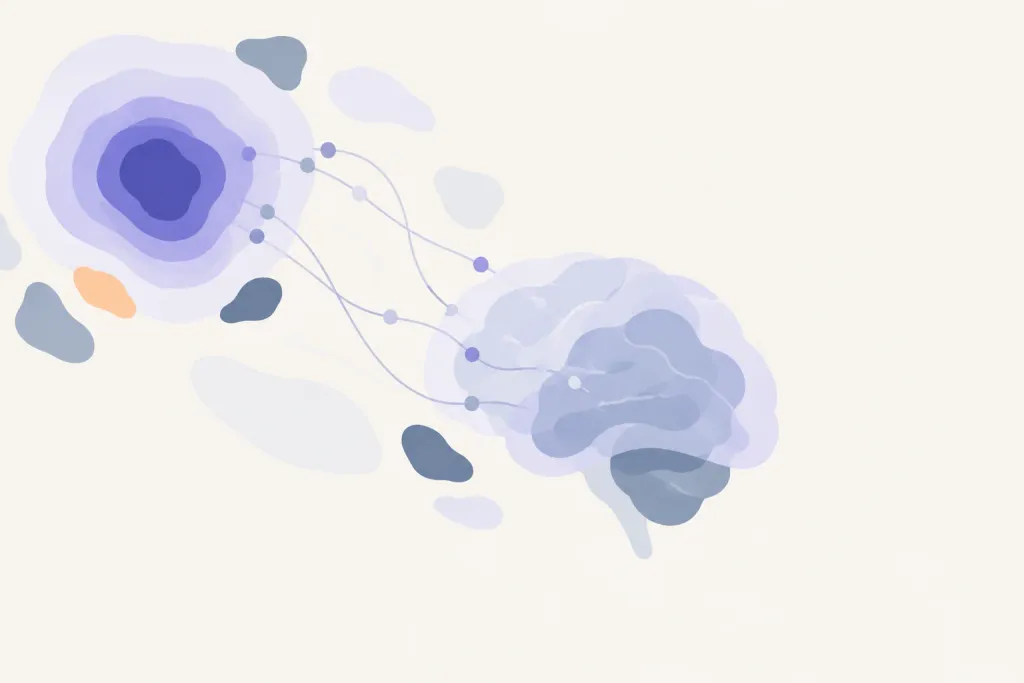
Researchers compared brain scans with scores on a test of thinking speed and working memory. They looked at lesions on the brain's outer layer and patterns of brain activity at rest. People with three or more of these lesions showed weaker links between brain activity and test scores than people with none. This pattern appeared in four brain networks, or groups of brain areas that work together. The findings suggest that more lesions may limit how brain activity supports thinking speed and working memory.
Who Should Care and Why
The study included older adults with MS. It focused on thinking speed and working memory, not physical symptoms. Each person had a brain scan and took a thinking test. The researchers compared people with no lesions, one or two lesions, and three or more lesions on the brain's outer layer. The results describe a link between lesions, brain activity, and test performance in this group.
Important Considerations
You should know this was an observational study of 82 older adults with MS. It shows links between brain scans and test scores, not that lesions caused a change in thinking. You cannot tell from this study whether the same pattern applies to younger people with MS.
AI-generated summary — for informational purposes only, not medical advice
Read the original abstract
Published in Brain imaging and behavior by et al.. Reproduced from the PubMed record.
Cortical lesions (CL) are common in older adults with multiple sclerosis (OAMS), but their influence on the relationship between resting-state network strength (RSNS) and cognitive function in OAMS remains underexplored. This study aimed to determine whether CL moderates associations between RSNS and processing speed in OAMS. 82 OAMS participants (mean age: 64.4 ± 4.1 years; males/females: 26/56) were scanned in a 3T scanner. Identification of CL on double inversion-recovery (DIR) MRI images in this study was performed using established consensus recommendations. We estimated functional brain networks using a data-driven procedure to extract seven intrinsic resting-state networks. The Symbol-Digit-Modalities Test (SDMT), an established test of processing speed and working memory, served as the cognitive outcome measure. Multiple linear regressions, adjusted for sociodemographic covariates, examined the relationship between RSNS and SDMT performance with CL (three levels: no CL, 1-2 CL, and ≥ 3 CL) as a moderator. Significant CL-by-network interactions in models adjusted for sociodemographic covariates and white matter lesion load indicated that high-burden CL vs. no CL moderated the association between RSNS and SDMT in the auditory network (AUD) (p = 0.030), dorsal attention network (DAN) (p = 0.033), left frontoparietal network (LFPN) (p = 0.030), and posterior DMN (pDMN) (p = 0.030). Conditional effects showed that high-burden CLs attenuated positive associations between specific brain networks and SDMT performance. These findings suggest that higher CL burden restricts the functional brain support for processing speed and working memory performance in OAMS.
Categories
Explore more research
Check out the MS Buddy app
It’s free, with no ads. Built by people living with MS.


Related MS research

11/17/2026
A review suggests MS fatigue may reflect extra effort to control movement and incomplete recovery af
Read More
11/16/2026
Computer studies found MS fatigue surveys can give similar group results but different individual sc
Read More
11/17/2026
A review found exercise, therapy focused on thoughts and behavior, and self-management programs show
Read More
11/17/2026
Donated MS brain tissue showed damage in a vision hub. Mouse findings linked local immune cell activ
Read More
11/16/2026
A planned study will use detailed brain scans and blood tests to explore why relapsing-remitting MS
Read More
1/1/2026
A study of 318 people with MS linked lower thinking test scores to more sexual difficulties, with th
Read MoreNot all studies carry the same weight: sample size, study design and whether results were replicated all matter. The credibility score above reflects the journal, and the original paper is linked under More Details. Read how MS Buddy selects and scores research, and talk to your MS care team before acting on any study.