New method identifies immune cells in an MS model study
By MS Buddy ·
Summarized from iScience, Nov 2026 · PubMed. AI-generated summary. Not medical advice.
Lab study · immune cells from disease models and people with autoimmune diseases
Research by Robert Kousnetsov, Daniel Hawiger and 1 colleague at Saint Louis University School of Medicine in the United States.
Can researchers identify immune cells that drive disease in an MS model?
Key Takeaway
Researchers identified shared patterns of gene activity that distinguish immune cells involved in autoimmune disease, including in an MS disease model.
What They Found
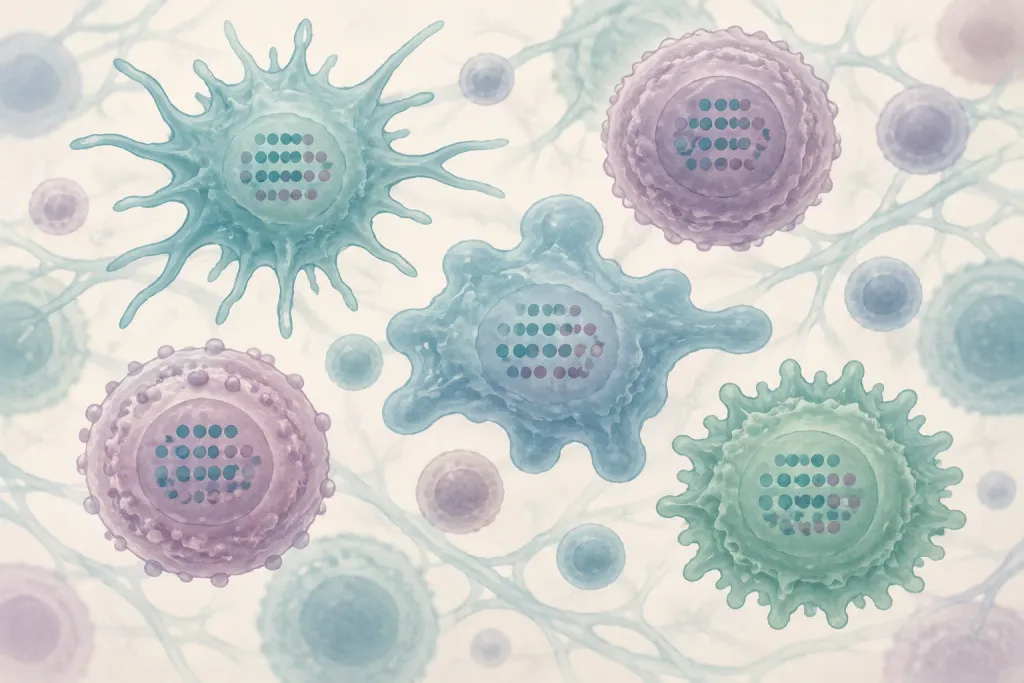
Researchers found shared patterns of gene activity in immune cells that help sustain attacks against the body's own tissues. These patterns distinguished the cells from other immune cells with similar features. Researchers confirmed that the identified cells contributed to disease in an MS model. They also detected cells with these patterns in people with related autoimmune diseases (conditions where the immune system attacks the body). APEX1 (a protein inside cells) was more active in these cells and was essential for their disease-causing functions in a disease model.
Who Should Care and Why
This study examined immune cells in laboratory disease models and in people with related autoimmune diseases. MS was part of the work through a disease model. The abstract does not name the human diseases studied. The findings concern immune cells that help sustain attacks against the body's own tissues. The study identifies a way to distinguish these cells and a protein they depend on.
Important Considerations
This was laboratory research using disease models and human cells, not a treatment trial. The abstract does not report how many people contributed cells. It does not show whether blocking the identified protein would help you or be safe in people with MS.
AI-generated summary — for informational purposes only, not medical advice
Read the original abstract
Published in iScience by . Reproduced from the PubMed record.
Stem-like T cells (TSTEM) critically govern autoimmune responses. Unlike individual transcriptional master regulators of specialized T cells, the primary molecular determinant of TSTEM, Tcf1, is shared with naive and other T cells. To unequivocally identify autoimmune TSTEM, we established transcriptomic characteristics conserved across multiple immunological settings. We leveraged such conserved features to faithfully distinguish TSTEM arising de novo among other Tcf1+ T cells and confirmed their autoimmune functions in vivo in a model of multiple sclerosis. We further detected the transcriptomically identifiable TSTEM in corresponding human diseases, and among such T cells we uncovered a specifically increased expression of apurinic/apyrimidinic endodeoxyribonuclease 1 (APEX1). By rigorously investigating Apex1-deficient TSTEM in a disease model, we confirmed indispensable roles of Apex1 in governing the disease-producing functions of autoimmune TSTEM. Thus, we established conserved features of autoimmune TSTEM across species barriers and uncovered APEX1/Apex1 as a functional determinant of TSTEM.
Categories
Explore more research
Check out the MS Buddy app
It’s free, with no ads. Built by people living with MS.


Related MS research
11/20/2026
A review looks at changes in how the body uses tryptophan (a building block of proteins) in MS and o
Read More
11/19/2026
Five people with MS received engineered immune cells. Spinal fluid immune changes were seen, but saf
Read More
11/20/2026
A small study followed brain connections and thinking in early MS over 10 months. Patterns differed
Read More
11/20/2026
A global study including childhood MS found rising rates and disability from rare childhood brain an
Read More
11/20/2026
Removing a protein that restrains immune cells worsened MS-like disease in mice. This laboratory stu
Read More
11/18/2026
A review finds limited direct evidence that diet, exercise, or gut microbes affect MS through the bo
Read MoreNot all studies carry the same weight: sample size, study design and whether results were replicated all matter. The credibility score above reflects the journal, and the original paper is linked under More Details. Read how MS Buddy selects and scores research, and talk to your MS care team before acting on any study.