Removing an immune brake worsened MS-like disease in mice
By MS Buddy ·
Summarized from iScience, Nov 2026 · PubMed. AI-generated summary. Not medical advice.
Animal study · immune cells and mice with MS-like disease or colon inflammation
Research by Sean Campbell, Laura Solt and 4 colleagues at the Herbert Wertheim UF Scripps Institute for Biomedical Innovation and Technology in the United States.
Does removing an immune cell brake worsen MS-like disease in mice?
Key Takeaway
Removing a protein that restrains immune cells worsened disease in mice with an MS-like illness.
What They Found
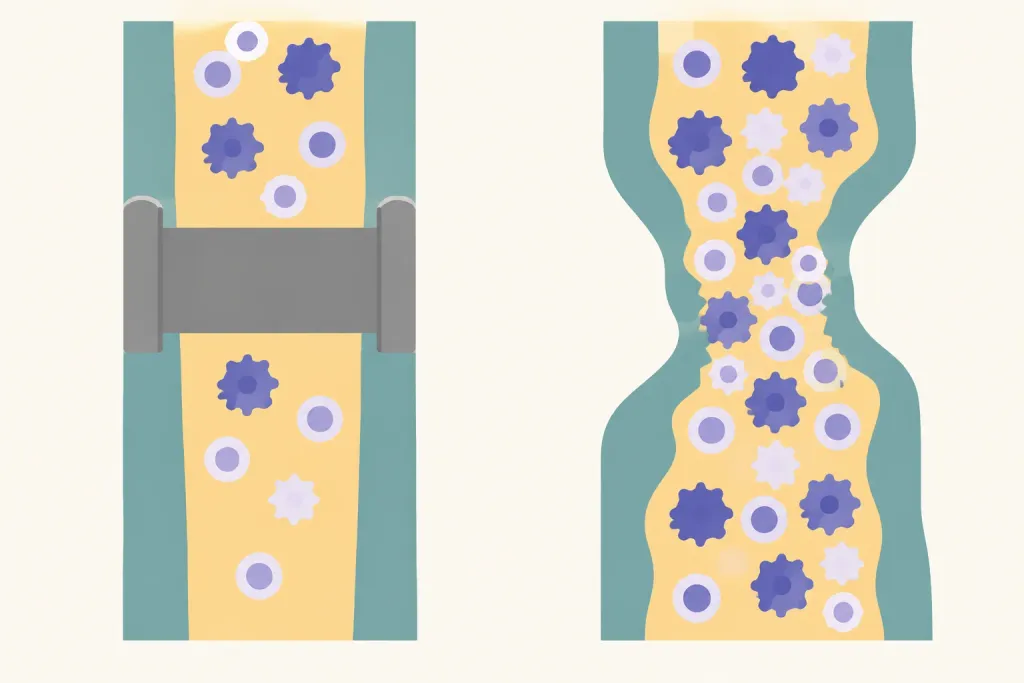
Removing REV-ERBβ (a protein that helps control immune cell activity) increased signals that promote inflammation. Its removal also worsened disease in mice with MS-like illness and mice with colon inflammation. The protein affected gene activity differently from a closely related protein previously studied by the researchers. It did not appear to rely strongly on the same partner protein to control gene activity. It also restrained immune cell activity without using a molecule known to bind to it.
Who Should Care and Why
This study examined immune cells and mice with MS-like disease or colon inflammation, not people with MS. It focused on immune cells that can drive attacks against the body's own tissues. The findings concern how these cells are normally kept under control. The researchers found that two closely related proteins controlled these cells in different ways. The study helps explain immune activity in these mouse diseases, rather than showing a treatment benefit in people.
Important Considerations
This was a laboratory and animal study, and the abstract gives no sample size. Removing a protein is not the same as testing a medicine that changes its activity. These findings do not show whether targeting this protein would help you manage MS.
AI-generated summary — for informational purposes only, not medical advice
Read the original abstract
Published in iScience by et al.. Reproduced from the PubMed record.
TH17 cells play a central role in several human autoimmune diseases. We and others reported the nuclear receptor, REV-ERBα, as a cell-intrinsic repressor of TH17-mediated pathogenicity. REV-ERBβ, REV-ERBα's closely related family member, is thought to be functionally redundant to REV-ERBα, which we sought to explore in TH17-mediated immunity. Our data indicate that deletion of REV-ERBβ enhances TH17-mediated pro-inflammatory cytokine expression and exacerbated disease in mouse models of multiple sclerosis and colitis. RNA-sequencing indicates REV-ERBβ and REV-ERBα do not have similar transcriptional profiles in TH17 cells. REV-ERBβ does not appear to strongly rely on interaction with the classic co-repressor NCoR1 to regulate gene expression, which is in contrast to REV-ERBα in TH17 cells, nor does it utilize heme, its known endogenous ligand for its repressive functions. Our results establish that while REV-ERBβ also acts as a negative regulator of TH17-cell function and pathogenicity, it does so in a manner that is non-redundant, independent, and unique to REV-ERBα.
Categories
Explore more research
Check out the MS Buddy app
It’s free, with no ads. Built by people living with MS.


Related MS research
11/20/2026
A review looks at changes in how the body uses tryptophan (a building block of proteins) in MS and o
Read More
11/19/2026
Five people with MS received engineered immune cells. Spinal fluid immune changes were seen, but saf
Read More
11/20/2026
A small study followed brain connections and thinking in early MS over 10 months. Patterns differed
Read More
11/20/2026
A global study including childhood MS found rising rates and disability from rare childhood brain an
Read More
11/20/2026
Researchers identified disease-driving immune cells in an MS model and related human diseases. Lab f
Read More
11/18/2026
A review finds limited direct evidence that diet, exercise, or gut microbes affect MS through the bo
Read MoreNot all studies carry the same weight: sample size, study design and whether results were replicated all matter. The credibility score above reflects the journal, and the original paper is linked under More Details. Read how MS Buddy selects and scores research, and talk to your MS care team before acting on any study.