Review explores how immune genes may shape MS damage
By MS Buddy ·
Summarized from Journal of autoimmunity, Nov 2026 · PubMed. AI-generated summary. Not medical advice.
Review · MS and people with harmful immune reactions to drugs
Research by Simon Mallal, Elizabeth Phillips and 1 colleague at Vanderbilt University Medical Center in the United States.
How might immune genes lead to tissue damage in MS?
Key Takeaway
This review proposes a way to study how immune genes may shape tissue damage in MS.
What They Found
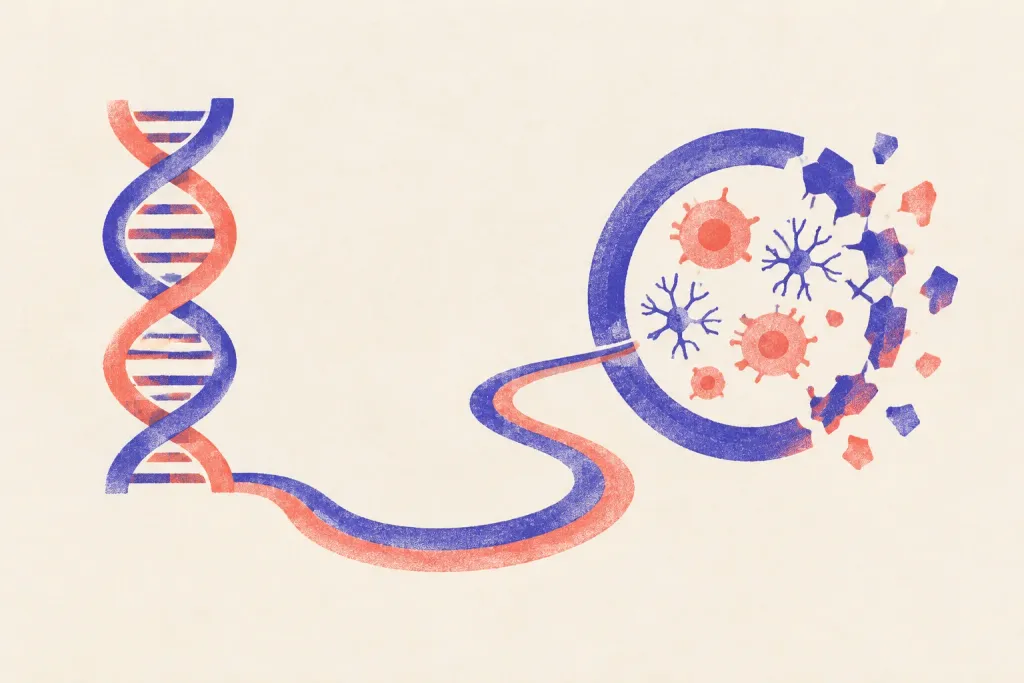
The authors compared MS with harmful immune reactions to drugs. They propose that immune genes may affect what the body recognizes, what keeps the reaction going, and where tissue is harmed. They also describe steps that may lead from lasting immune memory to local tissue damage. They say recognizing a target and making inflammation worse are different parts of that process. These are ideas for testing, not findings that establish what causes MS damage.
Who Should Care and Why
This review discusses MS and harmful immune reactions to drugs. It does not report a new study of people with MS. For people with MS, its main focus is how inherited immune differences might relate to tissue damage. The drug reactions provide a comparison for studying how immune responses begin. The authors suggest studying damaged tissue to test their ideas.
Important Considerations
This is a review that proposes a framework, not a treatment trial. It gives no sample size for a new study of people with MS. The proposed explanations still need testing, so they do not show what causes tissue damage in any one person.
AI-generated summary — for informational purposes only, not medical advice
Read the original abstract
Published in Journal of autoimmunity by . Reproduced from the PubMed record.
HLA associations are among the strongest genetic risk factors in immune-mediated disease, yet they rarely explain incomplete penetrance, tissue localization, or opposing effects of different alleles. We use T cell-mediated drug hypersensitivity and multiple sclerosis as complementary mechanistic anchors. Drug hypersensitivity shows that a defined exposure can create or alter a peptide-HLA surface and may recruit pre-existing class I-restricted memory in some early reactions, while allowing naive-derived responses in others. Patch-confirmed abacavir reactions beginning as early as 36 h, together with responses in drug-unexposed HLA-B*57:01 carriers, are difficult to reconcile with obligatory de novo naive priming in every case; in other drug hypersensitivity reactions the relative contributions of memory- and naive-derived cells to clinical injury remain unresolved. Multiple sclerosis adds a lifelong antigen source and separates HLA-DRB1*15:01-associated class II specificity from class I associations with measured Epstein-Barr virus burden and from candidate tissue execution. Together, these systems separate three HLA functions: specificity and focusing, antigen-source control, and tissue execution; and three temporal stages: imprinting and licensing, tissue recall, and local amplification. For T-cell receptor-mediated injury, we propose interacting requirements involving receptor-HLA compatibility, functional ligand and abundance, natural tissue presentation, and local regulation. Within this general architecture, Keystone Epitope Theory proposes that persistent, human-adapted organisms exert disproportionate influence on durable immune memory. That memory-source hypothesis is independently testable and is not a prerequisite for the broader framework. We distinguish antigenic target recognition from inflammatory amplification and propose a lesion-anchored, receptor-first experimental strategy with explicit disconfirming outcomes. Predictive-value calculations distinguish clinical screening decisions from mechanistic inference and show how measured modifiers can motivate competing, experimentally testable causal models.
Categories
Explore more research
Check out the MS Buddy app
It’s free, with no ads. Built by people living with MS.


Related MS research
11/20/2026
A review looks at changes in how the body uses tryptophan (a building block of proteins) in MS and o
Read More
11/19/2026
Five people with MS received engineered immune cells. Spinal fluid immune changes were seen, but saf
Read More
11/20/2026
A small study followed brain connections and thinking in early MS over 10 months. Patterns differed
Read More
11/20/2026
A global study including childhood MS found rising rates and disability from rare childhood brain an
Read More
11/20/2026
Removing a protein that restrains immune cells worsened MS-like disease in mice. This laboratory stu
Read More
11/20/2026
Researchers identified disease-driving immune cells in an MS model and related human diseases. Lab f
Read MoreNot all studies carry the same weight: sample size, study design and whether results were replicated all matter. The credibility score above reflects the journal, and the original paper is linked under More Details. Read how MS Buddy selects and scores research, and talk to your MS care team before acting on any study.