Review proposes how Epstein-Barr virus may drive MS
By MS Buddy ·
Summarized from Autoimmunity reviews, Nov 2026 · PubMed. AI-generated summary. Not medical advice.
Review · people with MS and related immune diseases
Research by Han Li, Wei Jiang and 1 colleague at Tianjin Medical University General Hospital in China.
How might the Epstein-Barr virus contribute to MS?
Key Takeaway
A review proposes a possible way the Epstein-Barr virus may contribute to MS, but the idea remains untested.
What They Found
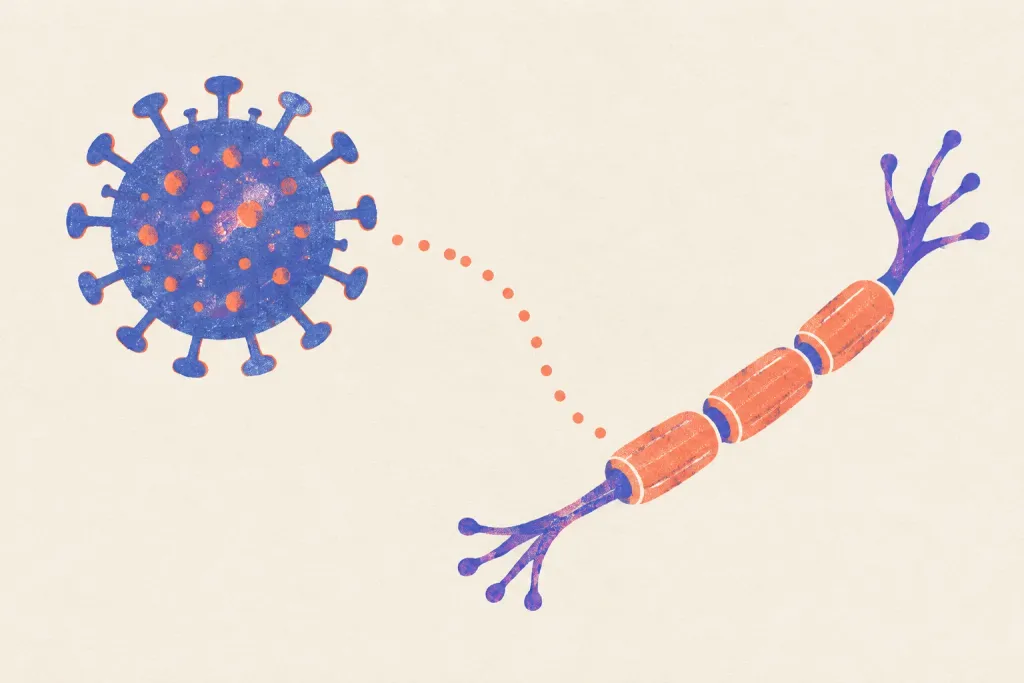
The authors propose a model, not a new study result. In their model, genes, age at infection, and environmental exposures may make it harder to control the Epstein-Barr virus. Infected immune cells may then move into the brain and spinal cord. There, the authors suggest, these cells may help trigger damage. The model brings several existing ideas about the virus and MS together.
Who Should Care and Why
This review discusses MS and other diseases in which the immune system attacks the brain or spinal cord. It does not report research in a new group of people. The authors focus on why a common virus might be linked to uncommon diseases. They also discuss other conditions sometimes mistaken for MS, but say the evidence linking them to the virus is limited. The review outlines ideas for preventing infection or targeting the virus or immune cells.
Important Considerations
You cannot tell from this review whether the proposed model is correct. The abstract gives no participant count and reports no new study testing the model. You cannot use it as evidence that any of the outlined treatment ideas work.
AI-generated summary — for informational purposes only, not medical advice
Read the original abstract
Published in Autoimmunity reviews by . Reproduced from the PubMed record.
Epstein-Barr virus (EBV) is a major environmental risk factor for multiple sclerosis (MS) and has also been linked-though with limited evidence-to other central nervous system (CNS) autoimmune diseases. The paradox of ubiquitous infection yet rare disease, along with fragmented hypotheses (molecular mimicry, Pender, Aloisi, driver, and hit-and-run hypotheses), highlights the need for a unifying model. Here, we propose a hypothetical "permissive-to-intrathecal activation model" in which genetic susceptibility, age at primary infection, and environmental exposures collectively lead to immune control failure of EBV-infected B cells (impaired immune surveillance and self-tolerance), allowing them to reprogram, migrate to the CNS, and become the central pathological hub, where intrathecal B-cell activation drives T-cell-mediated injury. Within this model, existing hypotheses can be integrated as specific components of this cascade. Based on the model, we outline three therapeutic strategies (primary prevention, EBV-directed, and B-cell-directed). Beyond MS, its core concepts-permissive conditions, immune control failure, and intrathecal activation-might provide a conceptual framework for other EBV-associated CNS autoimmune diseases, including neuromyelitis optica spectrum disorder (NMOSD), myelin oligodendrocyte glycoprotein antibody-associated disease (MOGAD), and autoimmune glial fibrillary acidic protein astrocytopathy (GFAP-A), despite limited epidemiological evidence. In this framework, disease-specific permissive conditions shape distinct patterns of immune control failure, which determines EBV's divergent roles, while intrathecal B-cell activation remains a shared process. This review may advance mechanistic understanding of EBV-driven CNS autoimmunity and provide a theoretical basis for precision intervention.
Categories
Explore more research
Check out the MS Buddy app
It’s free, with no ads. Built by people living with MS.


Related MS research
11/20/2026
A review looks at changes in how the body uses tryptophan (a building block of proteins) in MS and o
Read More
11/19/2026
Five people with MS received engineered immune cells. Spinal fluid immune changes were seen, but saf
Read More
11/20/2026
A small study followed brain connections and thinking in early MS over 10 months. Patterns differed
Read More
11/20/2026
A global study including childhood MS found rising rates and disability from rare childhood brain an
Read More
11/20/2026
Removing a protein that restrains immune cells worsened MS-like disease in mice. This laboratory stu
Read More
11/20/2026
Researchers identified disease-driving immune cells in an MS model and related human diseases. Lab f
Read MoreNot all studies carry the same weight: sample size, study design and whether results were replicated all matter. The credibility score above reflects the journal, and the original paper is linked under More Details. Read how MS Buddy selects and scores research, and talk to your MS care team before acting on any study.