Experimental drug eased MS-like disease signs in mice
By MS Buddy ·
Summarized from Neuropharmacology, Nov 2026 · PubMed. AI-generated summary. Not medical advice.
Animal study · Female mice with an MS-like disease and lab-grown cells
Research by Xiqin Fang, Xiaohong Chen and 6 colleagues at the Third Affiliated Hospital of Sun Yat-Sen University in China.
Did AVE0991 (an experimental drug) reduce signs of an MS-like disease in mice?
Key Takeaway
An experimental drug reduced nerve-related problems and inflammation in mice with an MS-like disease.
What They Found
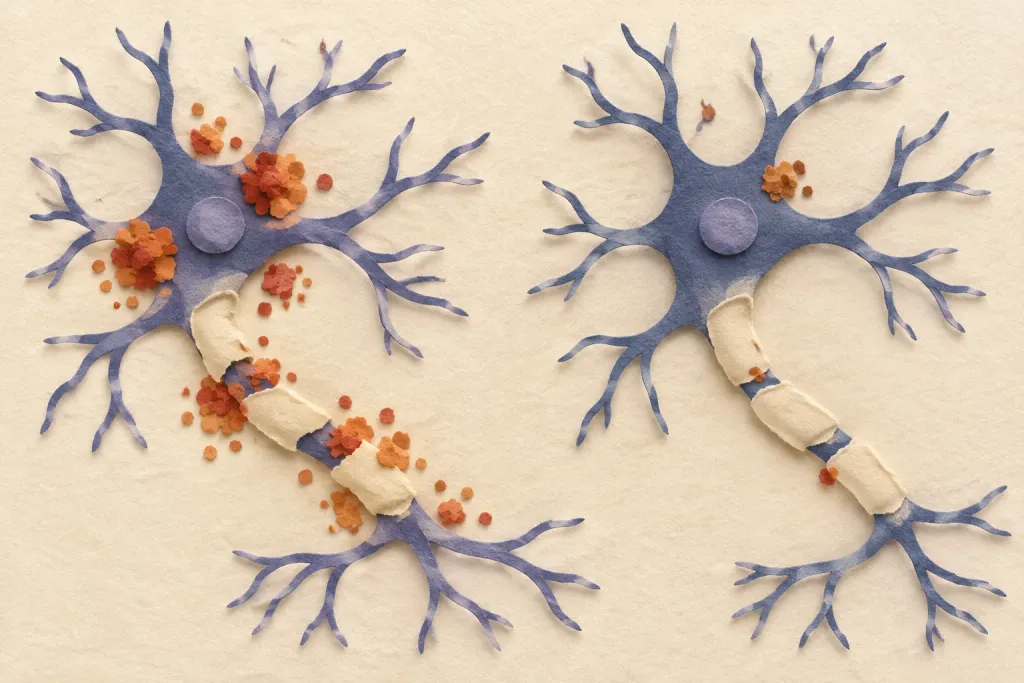
AVE0991 (an experimental drug) eased nerve-related problems in mice with an MS-like disease. It also reduced the buildup of immune cells in the brain and spinal cord. In lab-grown cells, the drug reduced immune responses that cause inflammation. The findings suggest the drug worked by switching on a cell signal that helps control inflammation. Other compounds that blocked parts of this process removed the drug’s inflammation-reducing effects.
Who Should Care and Why
The study involved female mice with an MS-like disease and cells grown in a lab. It did not study people with MS. Researchers examined changes in the mice’s spinal cords and their nerve-related problems. The cell experiments explored how the drug might reduce inflammation. These findings concern an early experimental approach, not an established MS treatment.
Important Considerations
The researchers started preventive treatment eight days after triggering the disease and continued it for 14 days. The abstract does not report how many mice were studied. This animal and lab study cannot show whether the drug would help you or be safe for people with MS.
AI-generated summary — for informational purposes only, not medical advice
Read the original abstract
Published in Neuropharmacology by et al.. Reproduced from the PubMed record.
Multiple sclerosis (MS) is a chronic inflammatory demyelinating disease of the central nervous system (CNS). Mas receptor (MasR) constitutes the counter-regulatory arm of the renin-angiotensin system. Despite well-established anti-inflammatory and neuroprotective effects of MasR, its functional roles and regulatory mechanisms in MS remain elusive. Herein, we established an experimental autoimmune encephalomyelitis (EAE) model in female C57BL/6 mice by immunization with MOG35-55, and prophylactically treated the mice with the selective MasR agonist AVE0991 starting on day 8 post-immunization for 14 consecutive days. The results showed that AVE0991 treatment reversed the downregulated MasR expression in the spinal cord of EAE mice, effectively alleviated neurological functional impairments, and mitigated excessive inflammatory infiltration in the CNS. MasR was verified to be expressed in IBA1+ cells, and transcriptomic profiling indicated its close association with immune regulation. In lipopolysaccharide-stimulated BV2 cells, AVE0991 significantly inhibited inflammatory responses. Mechanistically, MasR activation by AVE0991 facilitated Nrf2 nuclear translocation, thereby suppressing the TLR4/MyD88 signaling cascade and NF-κB nuclear translocation, and eventually inhibiting NLRP3. Consistently, the anti-inflammatory effects of AVE0991 were fully abolished by the MasR inhibitor A779, TLR4 agonist Neoseptin 3 or Nrf2 inhibitor ML385. And the protein-level alterations of the above molecules were also recapitulated in spinal cord homogenates from EAE mice. Collectively, our data suggest that AVE0991-mediated MasR activation ameliorates neurological deficits and neuroinflammation in EAE, possibly via Nrf2-dependent regulation of the TLR4/NF-κB/NLRP3 cascade. These findings identify a MasR-associated regulatory axis linked to neuroinflammation, which may provide a potential therapeutic strategy for MS.
Categories
Explore more research
Check out the MS Buddy app
It’s free, with no ads. Built by people living with MS.


Related MS research

11/17/2026
A review explores iron-driven cell death in MS and other diseases involving immune attacks on the bo
Read More
11/16/2026
In mice with damaged nerve coverings, fat-derived stem cells treated with metformin improved repair.
Read More
11/17/2026
Genetic and brain scan data linked inherited brain structure patterns to MS risk. Researchers also f
Read More
11/17/2026
Donated MS brain tissue showed damage in a vision hub. Mouse findings linked local immune cell activ
Read More
11/16/2026
A planned study will use detailed brain scans and blood tests to explore why relapsing-remitting MS
Read More
11/15/2026
In tissue from mice with an MS-like disease, a lab drug reduced excess chemical release from nerve e
Read MoreNot all studies carry the same weight: sample size, study design and whether results were replicated all matter. The credibility score above reflects the journal, and the original paper is linked under More Details. Read how MS Buddy selects and scores research, and talk to your MS care team before acting on any study.