Lab drug cut chemical release in MS-like mouse tissue
By MS Buddy ·
Summarized from Neuropharmacology, Nov 2026 · PubMed. AI-generated summary. Not medical advice.
Lab study · healthy mice and mice with an MS-like disease
Research by Nicole Rosenwasser, Anna Pittaluga and 5 colleagues at the University of Genoa in Italy.
Can a lab drug reduce excess chemical release in MS-like mouse tissue?
Key Takeaway
In spinal cord tissue from mice with an MS-like disease, a lab drug reduced excess chemical release from nerve endings.
What They Found
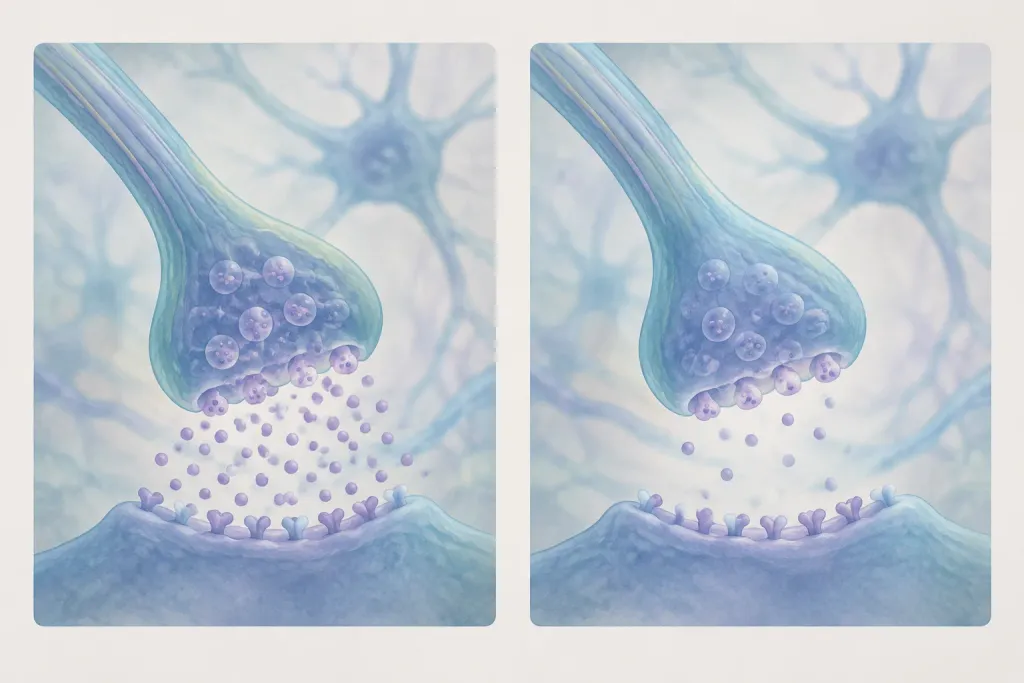
Spinal cord tissue from mice with an MS-like disease showed signs of nerve covering damage. It also showed signs of increased immune activity. Nerve endings in that tissue released more of a chemical linked to nerve signaling than those from healthy mice. The lab drug DF2593A reduced this release in tissue from mice with the MS-like disease. In tissue from healthy mice, DF2593A and another drug also reduced chemical release triggered by immune activity.
Who Should Care and Why
This study used healthy mice and mice with an MS-like disease, not people. Researchers tested nerve endings taken from the mice's spinal cords. The findings may interest people following early research on nerve signaling in MS. The study found changes in mouse tissue with an MS-like disease. It did not test whether changing those signals affects MS symptoms.
Important Considerations
You should know these were tests on mouse tissue, not a treatment study in people. The abstract does not state how many mice were studied. It does not show whether DF2593A improves symptoms or prevents nerve damage.
AI-generated summary — for informational purposes only, not medical advice
Read the original abstract
Published in Neuropharmacology by et al.. Reproduced from the PubMed record.
Complement releases glutamate from the spinal cord glutamatergic synaptosomes through mechanisms involving amino-acid transporters (EAATs) and G protein coupled receptors (GPCRs), as suggested by the efficiency of the EAAT blocker dl-t-BOA and of entrapped Pertussis toxin (PTx) to half its releasing activity. The GPCR-mediated component involves C5aR1s since the C5aR1 non-competitive negative allosteric modulator DF2593A and the orthosteric antagonist W54011 concentration-dependently prevent the complement-evoked release of preloaded [3H]D-aspartate. Antagonism, however, emerged only after the prolonged exposure of synaptosomes to these ligands, suggesting a multiple-phase model of receptor antagonism. Consistent with the involvement of this receptor, spinal cord synaptosomal lysates showed C5aR1 immunostaining corresponding to a dimeric assembly of the protein. We next examined mice suffering from the experimental autoimmune encephalomyelitis (EAE), at the acute stage of the disease (21 ± 1 days post immunization). Spinal cord homogenates from these mice show decreased MOG immunopositivity, suggestive of diffuse demyelination, but increased GFAP, vimentin, CD11b and CD45 staining, predictive of ongoing astrocytosis, microgliosis and infiltration of lymphocytes. These signs were paralleled by the overaccumulation of C1q, C3 and C5 components and increased C5aR1 staining, but conserved GLT1 one, in synaptosomal lysates. Lastly, the complement-evoked [3H]D-Aspartate overflow from spinal cord synaptosomes was amplified when compared to controls, but still significantly reduced by DF2593A. These findings prove the existence of presynaptic release-regulating DF2593A-sensitive C5aR1s in spinal cord glutamatergic terminals, opening the road to therapeutic application of C5aR1 modulators to control symptoms associated with altered synaptic transmission during multiple sclerosis.
Categories
Explore more research
Check out the MS Buddy app
It’s free, with no ads. Built by people living with MS.


Related MS research
11/17/2026
An experimental drug eased nerve-related problems and reduced inflammation in mice with an MS-like d
Read More
11/17/2026
A review explores iron-driven cell death in MS and other diseases involving immune attacks on the bo
Read More
11/16/2026
In mice with damaged nerve coverings, fat-derived stem cells treated with metformin improved repair.
Read More
11/17/2026
Genetic and brain scan data linked inherited brain structure patterns to MS risk. Researchers also f
Read More
11/17/2026
Donated MS brain tissue showed damage in a vision hub. Mouse findings linked local immune cell activ
Read More
11/16/2026
A planned study will use detailed brain scans and blood tests to explore why relapsing-remitting MS
Read MoreNot all studies carry the same weight: sample size, study design and whether results were replicated all matter. The credibility score above reflects the journal, and the original paper is linked under More Details. Read how MS Buddy selects and scores research, and talk to your MS care team before acting on any study.