MS study: Metformin-treated cells aided repair in mice
By MS Buddy ·
Summarized from Animal models and experimental medicine, Nov 2026 · PubMed · DOI. AI-generated summary. Not medical advice.
Animal study · mice with chemically damaged nerve coverings
Research by Fatemeh Taghizadeh, Iraj Ragerdi Kashani and 4 colleagues at the Tehran University of Medical Sciences in Iran.
Does treating stem cells with metformin improve nerve covering repair in mice?
Key Takeaway
Stem cells from fat tissue helped repair damaged nerve coverings in mice more effectively when treated with metformin before transplantation.
What They Found
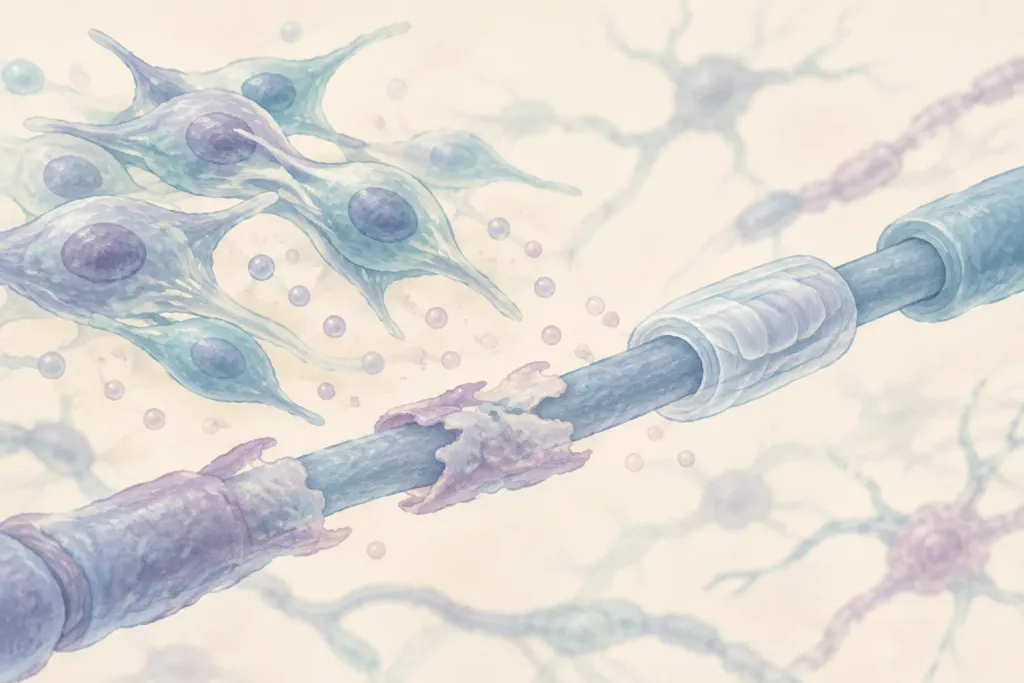
Researchers treated stem cells from fat tissue with metformin before transplanting them into mice with damaged nerve coverings. Metformin increased signs that these cells could move toward damaged areas. The treated cells improved repair of myelin (the protective covering around nerves). Treatment also increased a natural substance that may help reduce signals linked to a buildup of material around cells. These changes may help explain the improved repair, but the proposed explanation remains uncertain.
Who Should Care and Why
This study involved mice with chemically damaged nerve coverings, not people with MS. It explored a way to improve stem cell treatment before transplantation. The research relates to MS because MS damages the protective covering around nerves. The findings concern repair of that covering rather than relief of a specific symptom. The abstract does not identify a particular form of MS.
Important Considerations
This was an animal study, and the abstract does not report how many mice were included. It does not show whether this approach helps people with MS or is safe for them. You cannot tell from these results whether taking metformin alone would have the same effect.
AI-generated summary — for informational purposes only, not medical advice
Read the original abstract
Published in Animal models and experimental medicine by et al.. Reproduced from the PubMed record.
Multiple sclerosis (MS) is a demyelinating disease of the central nervous system (CNS). Changes in the microenvironment surrounding oligodendrocyte progenitor cells (OPCs), characterized by excessive production of extracellular matrix (ECM) components driven by elevated TGF-β and CTGF signaling, impair the remyelination capacity of these cells. Decorin (DCN), an endogenous inhibitor of the TGF-β/CTGF signaling axis, has emerged as a potential regulator of ECM homeostasis. To improve the therapeutic outcomes of stem cell-based strategies, adipose-derived mesenchymal stem cells (ADMSCs) were preconditioned with metformin (MET) before transplantation into a C57BL/6 mouse model of cuprizone-induced demyelination. Cell viability and the expression of CXCR4 and SDF-1α were evaluated to determine the migratory potential following MET preconditioning. Remyelination and oligodendroglial lineage dynamics were assessed using Luxol Fast Blue (LFB) staining and analysis of MBP and NG2 expression. ECM remodeling and mechanosensitive signaling were evaluated through the expression of DCN, TGF-β, CTGF, and Piezo 1. MET preconditioning was optimized at 1 mmol/L for 24 h based on MTT assay results and increased the migratory potential of ADMSCs, as indicated by upregulation of the CXCR4/SDF-1α axis. Histological analysis revealed enhanced remyelination, accompanied by increased MBP and reduced NG2 expression in treated groups. At the molecular level, transplantation of MET-preconditioned ADMSCs upregulated DCN while downregulating TGF-β, CTGF, and Piezo 1 expression. MET preconditioning enhances the therapeutic efficacy of ADMSCs through increasing migration and homing of these cells and consequently promotes remyelination in a cuprizone-induced demyelination model, potentially through DCN-mediated mechanisms.
Categories
Explore more research
Check out the MS Buddy app
It’s free, with no ads. Built by people living with MS.


Related MS research
11/17/2026
An experimental drug eased nerve-related problems and reduced inflammation in mice with an MS-like d
Read More
11/17/2026
A review explores iron-driven cell death in MS and other diseases involving immune attacks on the bo
Read More
11/17/2026
Genetic and brain scan data linked inherited brain structure patterns to MS risk. Researchers also f
Read More
11/17/2026
Donated MS brain tissue showed damage in a vision hub. Mouse findings linked local immune cell activ
Read More
11/16/2026
A planned study will use detailed brain scans and blood tests to explore why relapsing-remitting MS
Read More
11/15/2026
In tissue from mice with an MS-like disease, a lab drug reduced excess chemical release from nerve e
Read MoreNot all studies carry the same weight: sample size, study design and whether results were replicated all matter. The credibility score above reflects the journal, and the original paper is linked under More Details. Read how MS Buddy selects and scores research, and talk to your MS care team before acting on any study.