Shape tasks were harder for people with two forms of MS
By MS Buddy ·
Summarized from Neuropsychology, Nov 2026 · PubMed · DOI. AI-generated summary. Not medical advice.
Observational study · 83 people with relapsing-remitting or secondary progressive MS and healthy volunteers
Research by Hakan Karlı and Murat Kurt at Ordu University and Acibadem Mehmet Ali Aydinlar University.
How do people with two forms of MS do at turning shapes in their minds?
Key Takeaway
People with relapsing-remitting MS struggled more as a shape task got harder, while those with secondary progressive MS struggled at every level tested.
What They Found
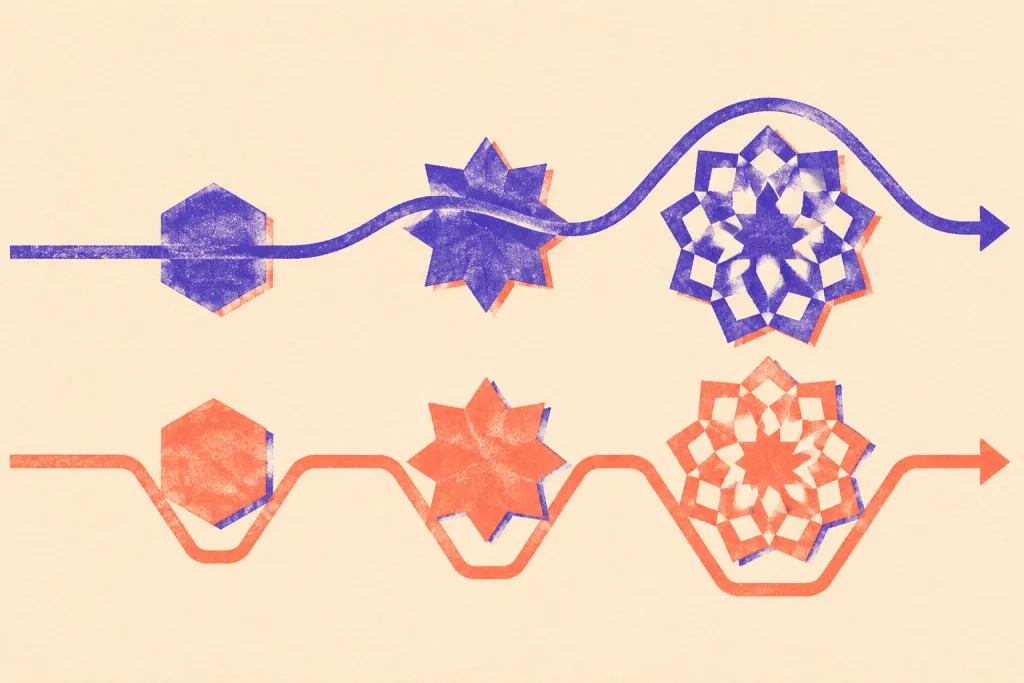
The main task asked people to picture shapes turning in their minds. Both MS groups answered more slowly and made more mistakes than healthy volunteers. In the relapsing-remitting MS group, performance dropped as the shapes were turned farther apart. The secondary progressive MS group had trouble at every angle tested. On other tests of shapes and space, the relapsing-remitting group had trouble in some areas, while the secondary progressive group had more widespread trouble.
Who Should Care and Why
The study included people with relapsing-remitting MS, people with secondary progressive MS, and healthy volunteers. It focused on how people think about shapes and where they are in space. For people with relapsing-remitting MS, trouble was more noticeable on harder tasks. For people with secondary progressive MS, trouble showed up across a wider range of tasks. The researchers suggest that these tests may help describe how thinking problems differ between the two forms of MS.
Important Considerations
This study compared 83 people across three groups. It does not show how these skills change over time. It did not test a treatment.
AI-generated summary — for informational purposes only, not medical advice
Read the original abstract
Published in Neuropsychology by . Reproduced from the PubMed record.
This study examined visuospatial cognition, particularly mental rotation performance, in patients with relapsing-remitting multiple sclerosis (RRMS) and secondary progressive multiple sclerosis (SPMS). The study included three groups: RRMS (n = 28), SPMS (n = 25), and healthy controls (n = 30). Participants completed a Shepard-Metzler-type mental rotation task (angular disparities: 0°, 50°, 100°, and 150°), along with a comprehensive visuospatial neuropsychological assessment. In the mental rotation task, the multiple sclerosis groups performed significantly worse than healthy controls in terms of reaction time and accuracy (RRMS: ds = 0.83-1.10; SPMS: ds = 2.28-2.61; ps < .003). A significant Group × Angle interaction emerged for both outcomes (partial η² = 0.15-0.21). The RRMS group showed angle-dependent declines, whereas the SPMS group showed impairments at all angles. Neuropsychological testing revealed selective deficits in the RRMS group and widespread impairment in the SPMS group. Visuospatial cognition, particularly mental rotation performance, differs according to multiple sclerosis subtype. While patients with RRMS exhibit selective impairments under conditions of high cognitive demand, those with SPMS show more pervasive performance deficits that are independent of task conditions. These findings suggest that visuospatial assessment may serve as a sensitive tool for characterizing the nature of cognitive involvement in patients with multiple sclerosis. (PsycInfo Database Record (c) 2026 APA, all rights reserved).
Categories
Explore more research
Check out the MS Buddy app
It’s free, with no ads. Built by people living with MS.


Related MS research

1/1/2026
In people with MS in Saudi Arabia, vitamin D levels had no simple link to pain or confidence in mana
Read More
11/20/2026
In a trial of 90 adults with MS, adding fatigue-focused talk therapy to supervised Pilates improved
Read More
11/20/2026
A review of three trials found remotely guided muscle exercises eased urine leaks and bladder overac
Read More
11/20/2026
A small study followed brain connections and thinking in early MS over 10 months. Patterns differed
Read More
11/19/2026
In a study of 379 people with MS and walking difficulties, home and facility exercise had similar wa
Read More
11/19/2026
Six fatigue questionnaires gave similar group results in MS, but individual scores differed for up t
Read MoreNot all studies carry the same weight: sample size, study design and whether results were replicated all matter. The credibility score above reflects the journal, and the original paper is linked under More Details. Read how MS Buddy selects and scores research, and talk to your MS care team before acting on any study.