New brain scan method better predicted thinking in MS
By MS Buddy ·
Summarized from Neuroinformatics, Nov 2026 · PubMed. AI-generated summary. Not medical advice.
people with MS and people without MS who had brain scans
Research by Trinh Ngoc Huynh, Guy Nagels and 10 colleagues at the VNU University of Engineering and Technology, Charles University and General University Hospital and 2 other institutions in Vietnam, the Czech Republic and Belgium.
Can a new brain scan method better predict thinking test scores in MS?
Key Takeaway
A new method for reading brain scans generally predicted thinking test scores in people with MS better than similar methods.
What They Found
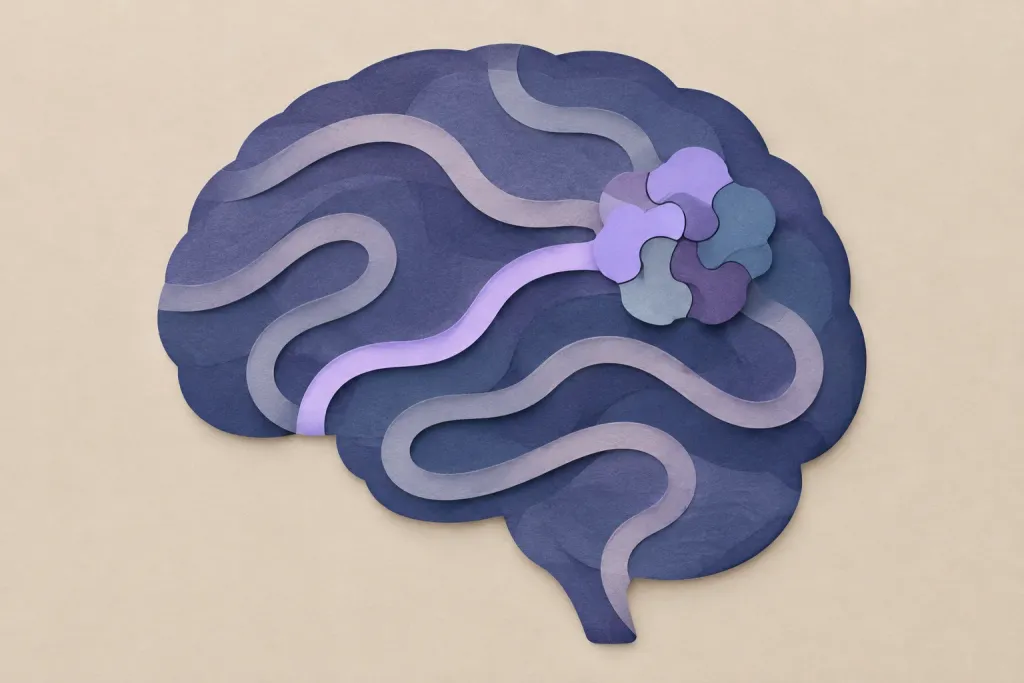
Researchers tested a new way to pull useful information from brain scans. It captured patterns related to sex and the amount of brain tissue. It generally rebuilt scan images more accurately than similar methods. It also generally predicted age and thinking test scores better than those methods. On the MS scans, its predictions were competitive with other computer methods.
Who Should Care and Why
The study used brain scans from people with MS and people without MS. The MS group also had thinking test scores. Researchers examined whether scan information could help predict those scores. The method also found patterns linked to brain tissue amounts. The findings concern a scan-analysis method, not an MS treatment.
Important Considerations
You cannot tell from the abstract how many people were studied. You also cannot tell whether this method would improve your care. The researchers tested predictions from existing scans, not whether the method changes thinking problems.
AI-generated summary — for informational purposes only, not medical advice
Read the original abstract
Published in Neuroinformatics by et al.. Reproduced from the PubMed record.
Neurological diseases can lead to significant cognitive impairment. Linking magnetic resonance imaging (MRI)-derived measures of brain structure with clinical assessments of cognitive function remains challenging, as conventional statistical methods and traditional machine learning approaches may struggle to capture complex relationships between brain structure and cognitive outcomes, hindering the development of reliable imaging biomarkers. Although deep learning methods offer greater predictive capabilities, their black-box nature limits interpretability, posing a major obstacle to clinical translation. Latent representation learning via generative models can provide informative representations and support deeper analysis and cognitive biomarker prediction. While standard generative adversarial networks and diffusion models primarily focus on generating images from random noise, variational autoencoders offer compact, probabilistic latent representations that are well suited for downstream tasks. In this study, we propose InfoVAE-Med3D, an adaptation of the InfoVAE framework for three-dimensional brain MRI to learn informative latent representations. By explicitly relaxing the mutual information regularization penalty between inputs and latent representations, our method aims to capture richer information from input MRI data, facilitating the analysis of brain-related characteristics and downstream prediction. We evaluate InfoVAE-Med3D on two datasets: a healthy control dataset ([Formula: see text]) containing chronological age and sex information, and a Multiple Sclerosis (MS) dataset ([Formula: see text]) collected from the Multiple Sclerosis Center of the First Medical Faculty, Charles University, Prague, containing chronological age, sex, and Symbol Digit Modalities Test (SDMT) scores. The learned latent representations capture information related to sex and brain volumetric features, including grey and white matter volumes, as reflected in sex-related clustering and smooth transitions in brain volume measures in two-dimensional visualizations. Through comprehensive evaluations, we demonstrate that InfoVAE-Med3D learns more informative latent representations, especially when the mutual information regularization penalty is completely removed. In this setting, the model generally outperforms other variational autoencoder variants in both MRI reconstruction and prediction of brain age and SDMT scores using support vector regression, while remaining competitive with deep learning-based predictive models, particularly on the MS dataset. InfoVAE-Med3D provides informative latent representations from brain MRI data of both healthy controls and patients with MS. By improving predictive performance and providing interpretable insights into the learned latent representations, the proposed framework offers a promising approach for advancing biomarker discovery and the analysis of cognitive impairment in neurological diseases, particularly MS.
Categories
Explore more research
Check out the MS Buddy app
It’s free, with no ads. Built by people living with MS.


Related MS research
11/17/2026
An experimental drug eased nerve-related problems and reduced inflammation in mice with an MS-like d
Read More
11/17/2026
A review explores iron-driven cell death in MS and other diseases involving immune attacks on the bo
Read More
11/18/2026
An adjusted MRI scan found more veins within MS brain lesions in 17 people with MS. It improved scan
Read More
11/16/2026
In mice with damaged nerve coverings, fat-derived stem cells treated with metformin improved repair.
Read More
11/17/2026
Genetic and brain scan data linked inherited brain structure patterns to MS risk. Researchers also f
Read More
11/17/2026
Donated MS brain tissue showed damage in a vision hub. Mouse findings linked local immune cell activ
Read MoreNot all studies carry the same weight: sample size, study design and whether results were replicated all matter. The credibility score above reflects the journal, and the original paper is linked under More Details. Read how MS Buddy selects and scores research, and talk to your MS care team before acting on any study.